Fire is one of the most destructive elements known to humanity. In a matter of minutes, an uncontrolled flame can reduce decades of hard work, structural investments, and priceless human lives to ash. However, fire is not a uniform threat. A blaze triggered by burning cardboard in a warehouse behaves entirely differently from an electrical short-circuit in a server room or a grease ignition in a commercial kitchen.
To effectively combat a fire, you must first understand its fuel source. Using the wrong fire extinguisher (Alat Pemadam Api Ringan / APAR) can fail to extinguish the flames and, in many cases, aggravate the situation—causing violent explosions, rapid flame propagation, or fatal electric shocks.
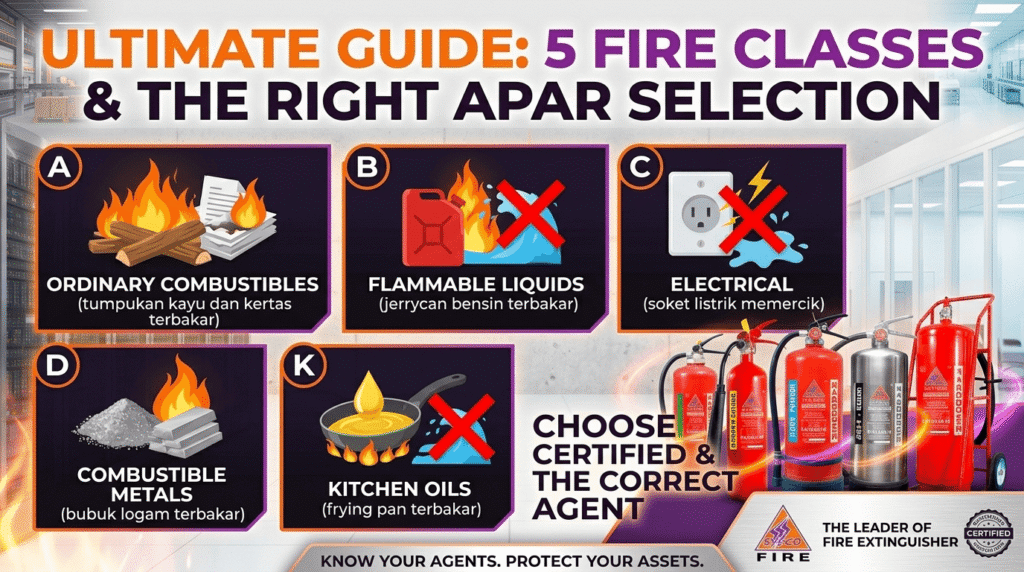
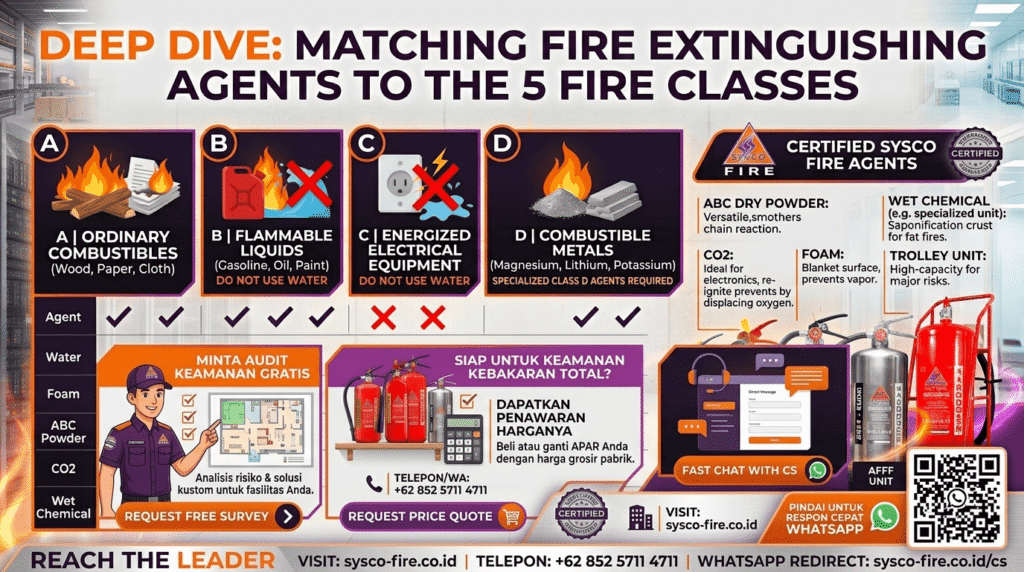
To prevent these hazards, fire safety standards categorize fires into distinct classes based on their fuel types. In this comprehensive, expert-level guide, we break down Classes A, B, C, D, and K, explain the science behind each fuel type, and match them with the exact APAR media required to safely put them out.
Table of Contents
The Chemistry of Fire: Understanding the Fire Tetrahedron
Before diving into the specific classes, it helps to understand how fire works. For combustion to occur and sustain itself, four critical components must be present simultaneously—a concept known as the Fire Tetrahedron:
- Fuel: Any combustible material (solid, liquid, gas, or metal).
- Heat: Thermal energy sufficient to raise the material to its ignition temperature.
- Oxygen: Ambient air (usually around 21% oxygen) to sustain combustion.
- Chemical Chain Reaction: The rapid oxidation process that continuously fuels the flame.
Different fire extinguishing agents target different sides of this tetrahedron. Some cool the heat, others displace the oxygen, and some interrupt the chemical reaction. The key to effective fire suppression is matching the right extinguishing media to the specific class of fire.
Class A Fires: Ordinary Combustibles
What is a Class A Fire?
Class A fires are the most common type of fire encountered in everyday life. They involve solid, organic, carbon-based materials that leave behind ash when burned.
- Common Fuel Sources: Wood, paper, cardboard, textiles, rubber, trash, and non-melting plastics.
- Typical Environments: Residential homes, general offices, school classrooms, paper warehouses, and woodworking workshops.
The Right APAR Media for Class A
Class A fires require an agent that provides a strong cooling effect to lower the temperature of the burning solid fuel below its ignition threshold.
- Water APAR: The classic and most cost-effective solution for pure Class A fires. Water cools the fuel source rapidly and penetrates deep into porous materials.
- Foam APAR (AFFF): Highly effective as it cools the fuel while laying down a thick blanket that smothers the embers.
- Dry Chemical Powder (ABC): An excellent multi-purpose agent. The powder coats the burning solids, forming a barrier that isolates the fuel from oxygen.
Safety Warning: Never use a plain Water APAR if there is any chance of electrical wiring nearby, as water conducts electricity and presents a severe electrocution hazard.
Class B Fires: Flammable Liquids and Gas
What is a Class B Fire?
Class B fires involve flammable or combustible liquids, petroleum greases, tars, oils, oil-based paints, solvents, lacquers, alcohols, and flammable gases (such as propane, butane, and methane).
- Common Fuel Sources: Gasoline, diesel, kerosene, paint thinners, alcohol, and industrial solvents.
- Typical Environments: Gas stations, auto repair shops, chemical processing facilities, paint booths, and industrial storage units.
The Right APAR Media for Class B
Extinguishing a Class B fire requires smothering the flames to cut off the supply of oxygen or interrupting the chemical reaction. Water must never be used on liquid fires, as it will sink below the burning oil and boil violently, splashing the burning fuel and expanding the fire instantly.
- Foam APAR (AFFF): The gold standard for liquid fires. Foam floats on top of the liquid surface, sealing in flammable vapors and cutting off oxygen completely.
- Carbon Dioxide ($CO_2$) APAR: Discharges non-flammable gas under pressure, replacing ambient oxygen surrounding the liquid pool with zero messy residue.
- Dry Chemical Powder (ABC / BC): Rapidly knocks down flames by breaking the chemical chain reaction above the liquid surface.
Class C Fires: Electrical Equipment
What is a Class C Fire?
Class C fires involve energized electrical equipment. The primary danger here is not just the fire itself, but the constant risk of lethal shock or electrocution to the person operating the extinguisher.
- Common Fuel Sources: Computer servers, electrical panels, transformers, circuit breakers, wiring looms, appliances, and electric motors.
- Typical Environments: Data centers, server rooms, telecommunication hubs, control rooms, power sub-stations, and modern office spaces.
The Right APAR Media for Class C
Agents used for Class C fires must be electrically non-conductive.
- Carbon Dioxide ($CO_2$) APAR: The absolute best choice for sensitive electronics. It is completely non-conductive, leaves zero residue, and causes no damage to delicate circuit boards or microchips.
- Dry Chemical Powder (ABC): Safe for electrical hazards because the powder is non-conductive. However, the fine powder leaves a dusty residue that can be difficult to clean and may damage microscopic components over time.
Pro-Tip: Once the electrical source is completely disconnected (de-energized), a Class C fire usually reverts to the base class of the burning material surrounding it (typically Class A or Class B).
Class D Fires: Combustible Metals
What is a Class D Fire?
Class D fires involve combustible reactive metals. These fires burn at extraordinarily high temperatures (often exceeding $2,000^\circ\text{C}$ to $3,000^\circ\text{C}$) and react violently with water, air, and standard chemical extinguishing agents.
- Common Fuel Sources: Magnesium, titanium, potassium, sodium, zirconium, lithium, and aluminum dust.
- Typical Environments: Metal fabrication plants, machining facilities, aerospace manufacturing, chemical laboratories, and specialized industrial workshops.
The Right APAR Media for Class D
Standard APAR units (Water, Foam, $CO_2$, or ABC Powder) must never be used on Class D fires. Water placed on burning magnesium splits into hydrogen and oxygen gases, resulting in a massive, catastrophic explosion.
- Specialized Class D Dry Powder APAR: Uses agents like sodium chloride, graphite, or copper-based powders. When applied, the powder melts over the burning metal, forming an airtight crust (flux) that smothers the flame and absorbs heat without reacting chemically with the metal.
Class K Fires: Cooking Oils and Fats
What is a Class K Fire?
Class K (or Class F in European standards) fires involve high-temperature vegetable oils, animal fats, and grease used in commercial cooking appliances.
- Common Fuel Sources: Deep-fryer oils, cooking fats, lard, and butter.
- Typical Environments: Commercial kitchens, hotel restaurants, fast-food outlets, food processing plants, and cafeteria kitchens.
The Right APAR Media for Class K
Vegetable oils burn at significantly higher ignition temperatures than standard flammable liquids. Standard Class B foam or $CO_2$ extinguishers lack the cooling capacity required to keep hot cooking oil from reigniting once the agent dissipates.
- Wet Chemical APAR: Specifically engineered for commercial kitchens. The specialized liquid solution mist triggers a reaction called saponification upon contact with hot fat. This process converts the burning oil into a thick, soapy, non-combustible foam layer that cools the oil rapidly, seals off oxygen, and prevents reignition.
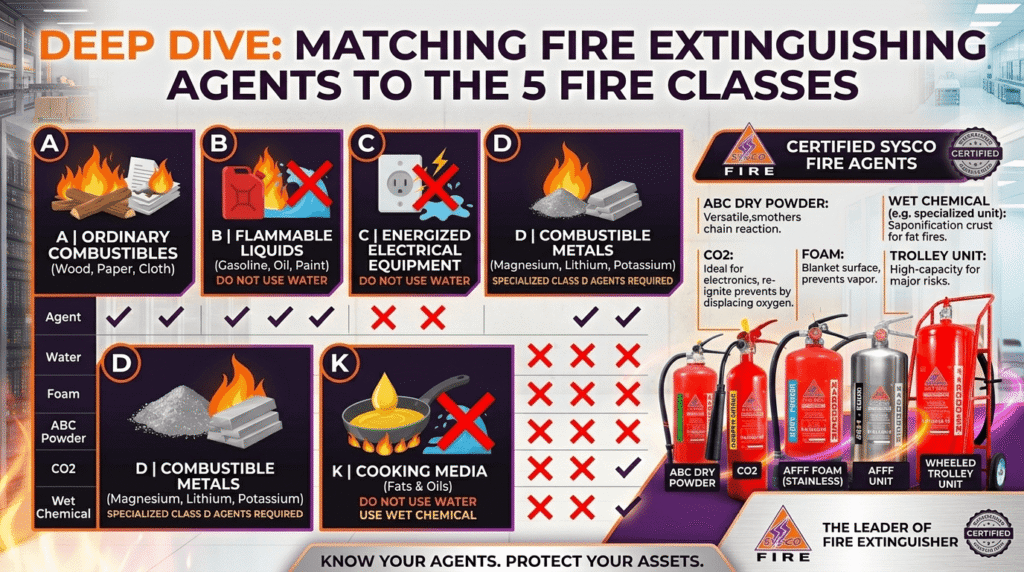
Summary Matrix: Matching Fire Classes to the Right APAR
To help you make fast, informed safety decisions, reference this complete matrix comparing fire classes against APAR media:
| Fire Class | Fuel Type | Primary Environments | Recommended APAR Media | Strictly Avoid |
| Class A | Solids (Wood, Paper, Plastic) | Homes, Offices, Warehouses | Water, Foam, ABC Dry Powder | — |
| Class B | Flammable Liquids & Gases | Gas Stations, Paint Shops, Factories | Foam (AFFF), $CO_2$, ABC Powder | Water (Explosive Spreading) |
| Class C | Energized Electrical Equipment | Server Rooms, Control Panels, Power Hubs | $CO_2$, ABC Dry Powder | Water, Foam (Electrocution Risk) |
| Class D | Combustible Metals | Machining Facilities, Aerospace Labs | Class D Powder (Sodium Chloride) | Water, Foam, $CO_2$, ABC Powder |
| Class K | Cooking Oils & Commercial Grease | Commercial Kitchens, Restaurants | Wet Chemical Agent | Water, $CO_2$, Standard Foam |
Conclusion
Understanding the distinct fire classes is not just technical jargon—it is a vital safety skill that saves lives and prevents catastrophic loss. Equipping your facility with the correct type of APAR ensures that when an emergency strikes, your team can act decisively, safely, and effectively. Regular inspections, proper placement, and purchasing certified equipment are essential steps in maintaining a robust fire safety strategy.
Baca juga : Refill APAR Terdekat Jakarta: 11 Hal yang Wajib Dicek Sebelum Memilih Jasa Isi Ulang
Partner with Indonesia’s Leading Fire Safety Manufacturer: Sysco-Fire
Don’t compromise on fire protection. Equip your facility, kitchen, or office with top-tier, certified APAR units manufactured to rigorous national and international safety standards.
- Visit Our Official Website: Discover comprehensive fire protection systems and corporate solutions at https://sysco-fire.co.id.
- Explore Our Product Line: Find the exact APAR media tailored to your industry’s specific hazard profile by visiting https://sysco-fire.co.id/Promo.
- Consult Our Safety Specialists: Need an audit or custom quote? Reach out to our expert team directly on WhatsApp at +62852-5711-4711 for immediate assistance today!