
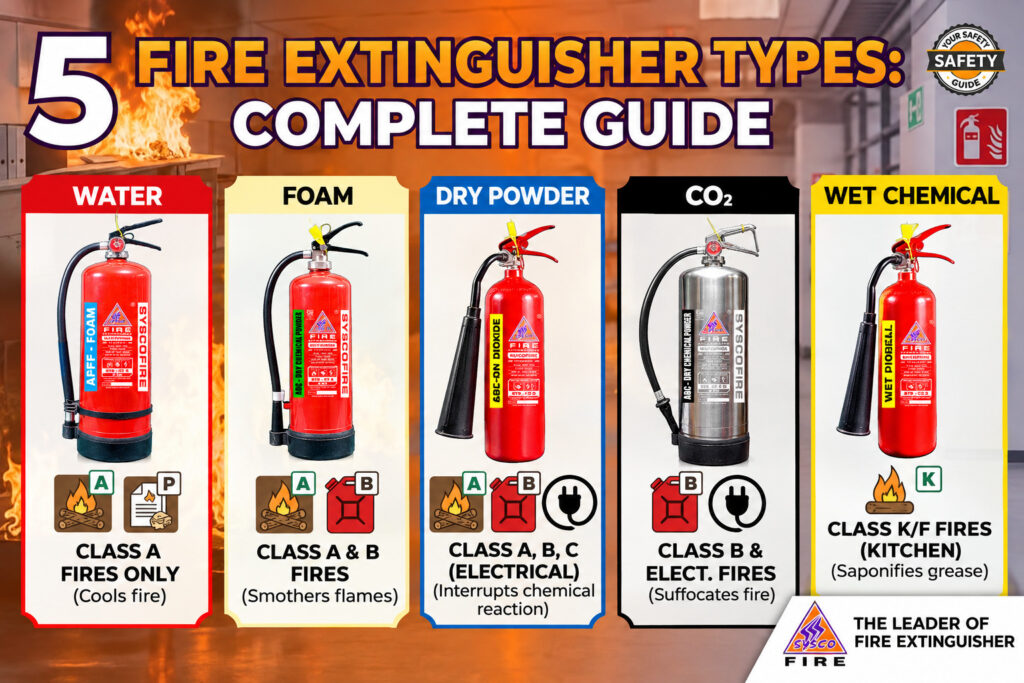
Imagine this terrifying scenario: a fire breaks out in your office. You rush to the wall, grab the nearest fire extinguisher, pull the pin, and spray it at the flames. But instead of dying down, the fire aggressively flares up, spreading faster and putting everyone in immediate danger.
How could this happen? The answer is simple yet often overlooked: not all fires are the same, and neither are fire extinguishers.
A common misconception among property owners is that any fire extinguisher (often referred to locally in Indonesia as APAR, or Alat Pemadam Api Ringan) can put out any fire. From an engineering and fire safety perspective, this is a dangerous myth. Using a water-based extinguisher on an electrical fire or a grease fire can lead to fatal electrocution or explosive fire spread.
To ensure absolute safety, you must adhere to the principles of E-E-A-T (Experience, Expertise, Authoritativeness, and Trustworthiness) in fire safety management. This means understanding the science of fire and equipping your premises with the correct tools. In this comprehensive guide, we will break down the 5 primary types of fire extinguishers, how they function, and where they should be deployed.
Table of Contents
The Foundation: Understanding Fire Classes
Before we dive into the types of extinguishers, you must first understand what you are fighting. Fires are categorized into different “Classes” based on the type of fuel that is burning. The fire extinguisher you choose must match the fire class of your specific environment.
- Class A: Involves ordinary combustible materials such as wood, paper, cloth, trash, and plastics.
- Class B: Involves flammable liquids and gases such as gasoline, petroleum oil, paint, and propane.
- Class C: Involves energized electrical equipment like motors, transformers, appliances, and server racks.
- Class D: Involves combustible metals like potassium, sodium, aluminum, and magnesium (typically found in industrial or laboratory settings).
- Class K: Involves cooking oils and greases, such as animal and vegetable fats (commonly found in commercial kitchens).
Now that we have established the classes of fire, let’s explore the 5 main types of fire extinguishers designed to combat them.
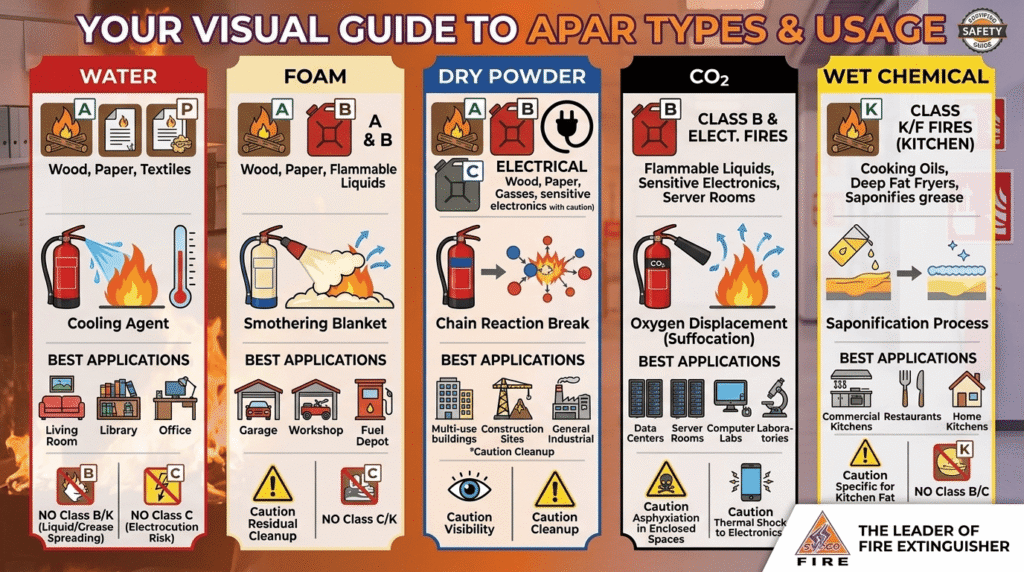
1. Water and Foam Fire Extinguishers
The Cooling Agents
Water and foam extinguishers are the oldest and most fundamental types of fire protection. They work by removing the heat element of the fire triangle.
- How They Function: Water extinguishers discharge a steady stream of H2O to drench the fire, lowering the temperature of the fuel below its ignition point. Foam extinguishers (often using AFFF – Aqueous Film-Forming Foam) go a step further. They discharge a soapy, sudsy foam that not only cools the fire but also creates a blanket over the fuel, preventing oxygen from reaching the flames and stopping the release of flammable vapors.
- Best Used For: Class A fires (wood, paper, textiles). Foam extinguishers are also highly effective on Class B fires (flammable liquids) because the foam floats on top of the liquid, sealing it off.
- Critical Warning: NEVER use water or standard foam extinguishers on Class C (electrical) fires, as water conducts electricity and poses a severe shock hazard to the operator. Furthermore, never use them on Class K (grease) fires, as the water will instantly vaporize, causing the burning oil to splatter and explode.
2. Dry Chemical Powder Fire Extinguishers
The All-Rounder (Multi-Purpose)
If you look at the APAR mounted in your hallway, garage, or local shopping mall, there is a very high probability it is a Dry Chemical Powder extinguisher. These are the most common extinguishers in the world due to their versatility.
- How They Function: These extinguishers are typically filled with monoammonium phosphate. When discharged, they release a fine chemical powder that coats the burning material. This powder interrupts the chemical reaction of the fire and creates a barrier between the fuel and the oxygen in the air.
- Best Used For: They are generally rated as ABC extinguishers, meaning they can safely handle Class A (ordinary combustibles), Class B (flammable liquids), and Class C (electrical fires). This makes them incredibly versatile and ideal for homes, schools, hospitals, and general office spaces.
- Critical Warning: While highly effective, the powder leaves a massive, corrosive mess. If used on sensitive electrical equipment (like computers or servers), the powder can ruin the microchips and circuit boards even after the fire is out. They also reduce visibility in closed spaces when discharged.
3. Carbon Dioxide (CO2) Fire Extinguishers
The Clean Suffocator
When dealing with highly sensitive environments where leaving a residue is unacceptable, Carbon Dioxide (CO2) extinguishers are the weapon of choice.
- How They Function: Fire requires oxygen to burn. CO2 extinguishers are filled with highly pressurized, non-flammable carbon dioxide gas. When activated, the heavy CO2 gas bursts out and violently displaces the oxygen surrounding the fire, effectively suffocating it. Furthermore, because the gas is highly compressed, it expels at a freezing temperature (dry ice snow), which helps to temporarily remove the heat from the fire triangle.
- Best Used For: Class B (flammable liquids) and Class C (electrical) fires. Because CO2 is a gas, it leaves zero residue, making it the perfect APAR for server rooms, data centers, laboratories, and electrical panel rooms.
- Critical Warning: CO2 extinguishers should not be used in confined, unventilated spaces as they aggressively displace oxygen, which can pose an asphyxiation risk to humans. They are also relatively ineffective on Class A fires, as the fire can easily re-ignite once the CO2 gas dissipates.
4. Clean Agent (Halotron / FK-5-1-12) Extinguishers
The High-Tech Protector
Clean agent extinguishers are the modern, environmentally friendly successors to the old Halon extinguishers (which were banned due to ozone depletion). They provide the same residue-free benefits of CO2 but with distinct advantages.
- How They Function: Clean agents, such as Halotron or Novec 1230, are discharged as a rapidly evaporating liquid or gas. Instead of just displacing oxygen, they chemically interrupt the combustion chain reaction. They absorb massive amounts of heat incredibly fast without dropping oxygen levels to dangerous points for human operators.
- Best Used For: Like CO2, they are ideal for Class B and C fires, and larger models carry a Class A rating. They are the premium choice for protecting high-value assets: art galleries, museums, aviation facilities, telecommunication centers, and advanced medical equipment rooms. They leave no residue and cause zero thermal shock to sensitive electronics.
- Critical Warning: Clean agent extinguishers are significantly more expensive than standard dry chemical units. However, the investment is minuscule compared to the cost of replacing a destroyed multi-million-dollar server rack.
5. Wet Chemical Fire Extinguishers
The Kitchen Lifesaver
Commercial kitchens are high-risk environments. Deep fat fryers operate at extreme temperatures, and a grease fire cannot be tamed by standard extinguishers. Enter the Wet Chemical extinguisher.
- How They Function: These extinguishers contain a special liquid chemical, usually a potassium acetate-based solution. When sprayed onto burning cooking oil, a chemical reaction called saponification occurs. The chemical reacts with the fat to create a thick, soapy foam on the surface of the oil. This foam acts as an impenetrable blanket, trapping the combustible vapors and rapidly cooling the oil down below its auto-ignition temperature.
- Best Used For: Class K fires. This is an absolute legal and safety requirement for commercial kitchens, restaurants, and food processing plants. They can also be used on Class A fires if necessary.
- Critical Warning: They discharge in a fine mist to prevent splashing the burning grease. It is critical to empty the entire contents of the extinguisher to ensure the oil is completely cooled, preventing re-ignition.
Conclusion: Matching the Tool to the Threat
Fire safety is not a guessing game. Equipping your building with an APAR is a vital step, but having the wrong type of APAR provides a false sense of security that can end in tragedy. By understanding these 5 distinct types of fire extinguishers—Water/Foam, Dry Chemical Powder, CO2, Clean Agent, and Wet Chemical—you can make informed, expert decisions to protect your property, your assets, and most importantly, human lives. Evaluate the specific hazards in your rooms, kitchens, or industrial spaces, and choose the fire extinguisher designed to neutralize that exact threat.
Baca juga : Sertifikasi K3 Kebakaran: 11 Kompetensi Penting untuk Meningkatkan Skill di Dunia Kerja
Upgrade Your Fire Safety with Sysco-Fire
Don’t compromise when it comes to the safety of your business and family. Ensure you have the right, certified fire protection equipment tailored to your specific environment.
- Discover Our Expertise: Visit our official website to learn more about our comprehensive fire protection solutions at https://sysco-fire.co.id.
- Find Your APAR: Browse our complete catalog of premium, certified fire extinguishers (APAR) for all fire classes. See the details here: https://sysco-fire.co.id/apar-alat-pemadam-api-kebakaran.
- Consult with the Experts: Unsure which fire extinguisher you need? Get free professional advice and pricing from our specialists! Contact us via WhatsApp at +62852-5711-4711 (Click here to chat instantly: https://sysco-fire.co.id/cs).