When it comes to corporate fire safety, purchasing top-of-the-line fire extinguishers is only the first step. A common and potentially fatal mistake made by many facility managers and business owners is assuming that simply placing a fire extinguisher (often known as APAR or Alat Pemadam Api Ringan in Indonesia) in a corner or a random cabinet is sufficient to protect their employees and assets.
In reality, a fire extinguisher is completely useless if it cannot be quickly located, easily accessed, and safely operated during the chaotic first moments of a fire emergency. This is exactly why international safety bodies, particularly the National Fire Protection Association (NFPA), have established rigorous standards governing the exact placement, mounting, and distribution of fire safety equipment.
For modern enterprises, relying on guesswork or DIY installation methods is no longer acceptable. In this comprehensive guide, we will explore why professional fire extinguisher installation services that adhere strictly to NFPA 10 standards are a non-negotiable requirement for companies, and how expert placement acts as your ultimate defense against catastrophic loss.
Table of Contents
Why DIY Fire Extinguisher Installation is a Corporate Liability
In a corporate environment, safety is not just a moral obligation; it is a strict legal and financial mandate. Choosing to install fire extinguishers without professional guidance exposes a company to several severe risks:
- Failed Safety Audits and Legal Penalties: Local fire departments and occupational safety boards conduct regular inspections. If your APAR units are installed at the wrong height, hidden behind obstacles, or spaced too far apart, your facility will fail these audits, resulting in heavy fines or operational shutdowns.
- Insurance Invalidation: Commercial property insurance policies require strict adherence to recognized fire safety codes. If a fire breaks out and investigators determine that the extinguishers were improperly installed or inaccessible, the insurance company may legally deny your claim, leaving your business to absorb the total cost of the damage.
- Human Safety Risks: In an emergency, panic takes over. If an employee has to search for an extinguisher, struggle to pull it out of an improperly sized bracket, or walk toward a fire hazard to reach it, the chances of injury or death increase exponentially.
Understanding NFPA 10: The Gold Standard for APAR Placement
The NFPA 10 (Standard for Portable Fire Extinguishers) is the internationally recognized benchmark that dictates precisely how fire extinguishers should be selected, installed, inspected, and maintained. A professional installation service ensures that your corporate facility meets every single mandate outlined in this comprehensive document.
1. Strict Height and Mounting Regulations
Fire extinguishers are heavy, pressurized steel cylinders. If they fall, they can cause severe injury or damage the valve, rendering the unit inoperable. Furthermore, they must be mounted at a height where anyone—regardless of their physical stature—can easily lift them off the wall. According to NFPA 10:
- For extinguishers weighing under 40 lbs (approx. 18 kg): The top of the extinguisher must be no higher than 5 feet (1.5 meters) above the floor.
- For heavier extinguishers weighing over 40 lbs: The top must be no higher than 3.5 feet (1.07 meters) above the floor.
- Floor Clearance: The bottom of the extinguisher must always remain at least 4 inches (10 cm) above the floor to prevent rust, accidental kicking, and interference with cleaning equipment.
2. Travel Distance and Hazard Mapping
You cannot simply place one extinguisher at the end of a massive warehouse and call it a day. NFPA 10 dictates the maximum “travel distance”—the actual walking path, navigating around desks, walls, and machinery—an employee must take to reach an extinguisher.
- Class A Hazards (Ordinary combustibles like paper, wood, and office furniture): The maximum travel distance to a Class A rated extinguisher must not exceed 75 feet (22.8 meters).
- Class B Hazards (Flammable liquids like fuels and solvents): Because these fires spread incredibly fast, the travel distance is reduced to 30 to 50 feet (9 to 15 meters), depending on the hazard level and the extinguisher’s rating.
Specialized Installation for Different Corporate Environments
A professional installation service does not use a “one-size-fits-all” approach. Different areas of your company face entirely different chemical threats. An expert team will map your facility and install the correct type of APAR in the correct zone.
The General Office Space
Office areas are primarily categorized as light/ordinary hazard zones filled with Class A materials (paper, desks, fabric) and Class C hazards (computers, printers, wiring).
- Installation Strategy: Multi-purpose Dry Chemical (ABC) extinguishers or Water/Foam extinguishers are strategically mounted in main corridors, near exit doors, and at pathway intersections. They must be clearly marked with 3D photoluminescent signs so they are visible even during a power outage.
Data Centers and Server Rooms
A single spark in a server room can destroy millions of dollars worth of IT infrastructure. However, using a standard Dry Chemical powder extinguisher here will cause just as much damage to the microchips as the fire itself.
- Installation Strategy: Clean Agent (such as Halotron) or Carbon Dioxide (CO2) extinguishers are strictly required here. These leave zero residue and are non-conductive. Professionals will install these just outside or immediately inside the entrance of the server room, ensuring personnel do not have to venture deep into a smoke-filled room to arm themselves.
Manufacturing Floors and Warehouses
Industrial spaces often contain high-risk Class B (flammable liquids) and Class C (heavy electrical machinery) hazards.
- Installation Strategy: Heavy-duty, high-capacity extinguishers are required. In vast warehouses, professional installers will mount the units on prominent structural pillars, painting the pillars with bright red bands or using highly elevated signage so the extinguisher’s location is visible across the entire floor, even above stacked inventory.
Commercial Kitchens and Cafeterias
Corporate cafeterias with deep fryers face Class K (cooking oil) hazards.
- Installation Strategy: NFPA regulations mandate that a Wet Chemical fire extinguisher must be installed within a travel distance of 30 feet (9 meters) from the commercial cooking equipment. It must be placed along the path of egress (the exit route) so kitchen staff can grab it while moving away from the flames.
The Professional Installation Process: What to Expect
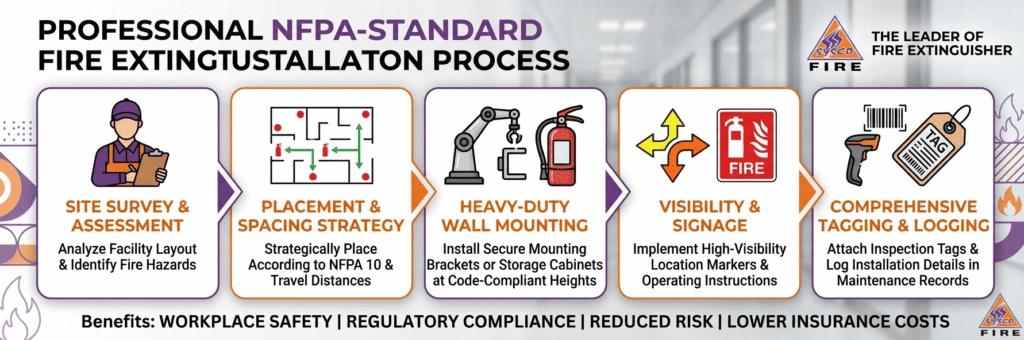
When you hire a certified fire safety company to handle your APAR installation, you are investing in a rigorous, multi-step engineering process:
- Comprehensive Site Survey: Certified technicians conduct a walkthrough of your entire facility to identify specific fire hazards, high-risk zones, and emergency exit routes.
- Strategic Mapping: The team calculates travel distances and designs a customized placement map that complies 100% with NFPA 10 and local building codes.
- Hardware Installation: Using heavy-duty, approved brackets or specific fire extinguisher cabinets, the technicians mount the units securely to the walls, ensuring the structural integrity of the mounting surface.
- Signage and Tagging: High-visibility, glow-in-the-dark signage is installed above every unit. Finally, every extinguisher is inspected, physically tagged, and entered into a maintenance database with its specific installation date and upcoming inspection schedule.
Conclusion
Protecting your company’s personnel, critical data, and physical infrastructure is an immense responsibility. A fire extinguisher is your first line of defense in the critical seconds before the fire department arrives, but its effectiveness relies entirely on its accessibility. By utilizing professional fire extinguisher installation services that strictly follow NFPA standards, you eliminate the guesswork from fire safety. You ensure total legal compliance, protect your insurance policies, and most importantly, provide your employees with a secure, well-prepared working environment. Don’t leave your corporate safety to chance—trust the experts to map, mount, and manage your fire protection systems.
Baca juga : 11 Komponen Utama Fire Alarm System dan Fungsinya, Wajib Dipahami Sebelum Memasang
Secure Your Business with Sysco-Fire’s Expert Installation Services
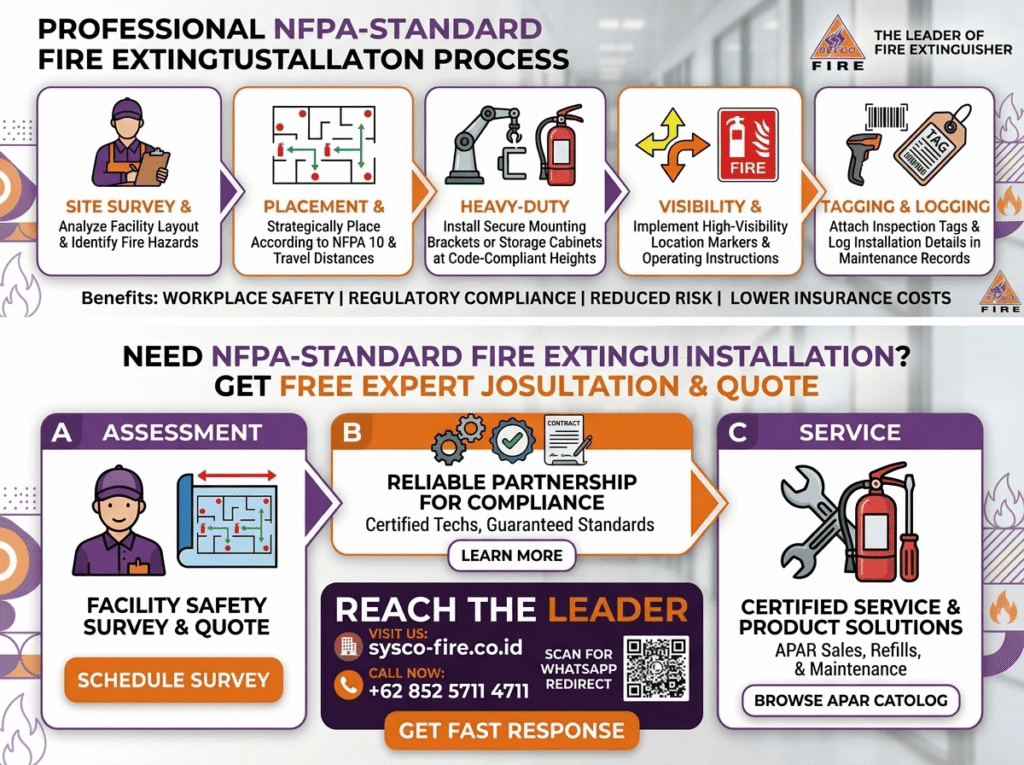
Is your corporate facility fully compliant with national and international fire safety standards? Don’t wait for an audit or a devastating emergency to find out. Partner with the industry leaders in fire protection.
- Visit Our Official Website: Discover our full range of corporate fire safety solutions and professional installation services at https://sysco-fire.co.id.
- Explore Certified Products: Need to upgrade your current equipment? Browse our catalog of NFPA-compliant and certified APAR units here: https://sysco-fire.co.id/promo.
- Book Your Site Survey Today: Ready to schedule a professional installation or need expert consultation for your commercial building? Contact us instantly via WhatsApp at +62852-5711-4711 and let our certified technicians secure your assets today!