
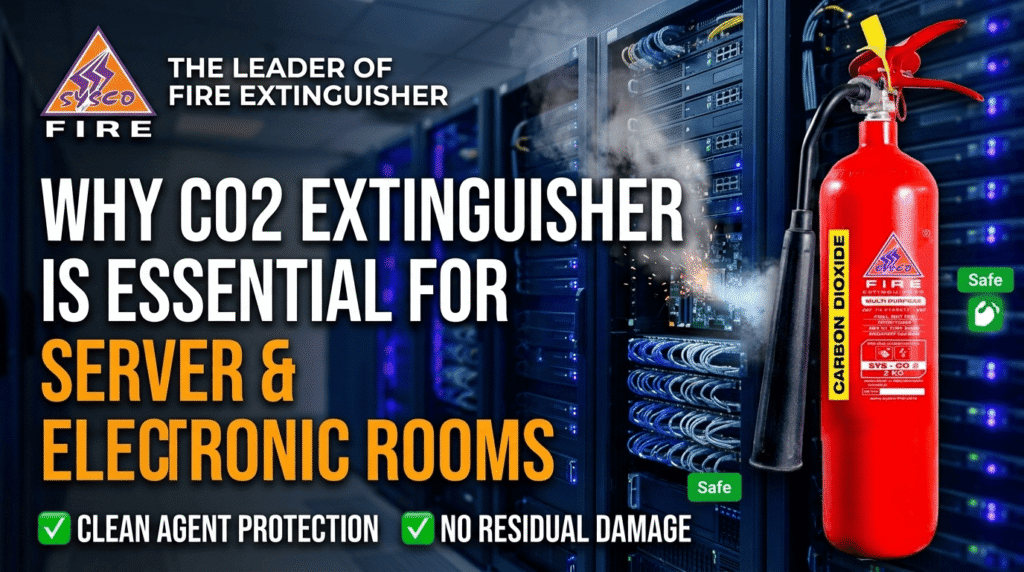
In today’s digital-driven economy, server rooms, data centers, and control hubs serve as the central nervous system of modern businesses. A single rack of servers can process millions of transactions, house invaluable proprietary data, and maintain essential communication networks. However, these environments are uniquely vulnerable to a quiet, destructive threat: electrical fires.
When fire breaks out in a room packed with high-voltage electronics, sensitive microprocessors, and dense cabling, standard fire suppression methods can often inflict more damage than the flames themselves. Using the wrong extinguishing agent—such as water, foam, or dry chemical powder—can permanently ruin millions of dollars in hardware in seconds.
This is precisely why Carbon Dioxide (CO2) fire extinguishers are considered an absolute necessity for server rooms, computer labs, telecommunications facilities, and electronic manufacturing spaces. Below is an in-depth analysis of why CO2 is the ultimate fire protection solution for sensitive electrical environments, how it works, and how to implement it effectively.
Table of Contents
Understanding Electrical Fire Hazards in Tech Infrastructures
Server rooms present a distinct fire profile categorized primarily as Class C (Electrical) fires, which often transition into Class B (flammable liquid/insulation) fires if left unchecked. Understanding how these fires originate helps explain why specialized suppression is mandatory.
Common Causes of Server Room Fires
- Component Overheating: High-density server stacks run continuously. If cooling systems fail or air vents become blocked, components can overheat and ignite nearby circuit boards or wire insulation.
- Electrical Short Circuits & Surges: Damaged wiring, faulty power distribution units (PDUs), or overloaded power strips can arc, sparking localized fires inside closed server cabinets.
- Uninterruptible Power Supply (UPS) Failures: Lithium-ion or lead-acid batteries stored in UPS rooms are prone to thermal runaway, leading to rapid heat generation and violent fire outbreaks.
- Sub-floor Cabling Degradation: Thousands of meters of copper and fiber optic cables ran under raised floors can degrade, pinched under heavy equipment, generating heat unseen until smoke rises.
In these environments, traditional fire suppression systems pose a severe dilemma: extinguishing the flame while unwittingly destroying the operational integrity of surrounding equipment.
How CO2 Fire Extinguishers Work
Carbon Dioxide extinguishers store pure CO2 gas under immense pressure in a heavy-duty cylinder, transforming it into a liquid state. When discharged, the pressure drops rapidly, causing the CO2 to expand instantly into a dense, freezing cloud of gas.
The Mechanism of Suppression
Fire requires three elements to sustain combustion—the classic Fire Triangle: Heat, Fuel, and Oxygen. CO2 targets two sides of this triangle simultaneously:
- Oxygen Displacement: CO2 gas is heavier than air. Upon discharge, it blankets the fire, displacing oxygen around the fuel source and reducing atmospheric oxygen levels below the threshold needed to sustain combustion.
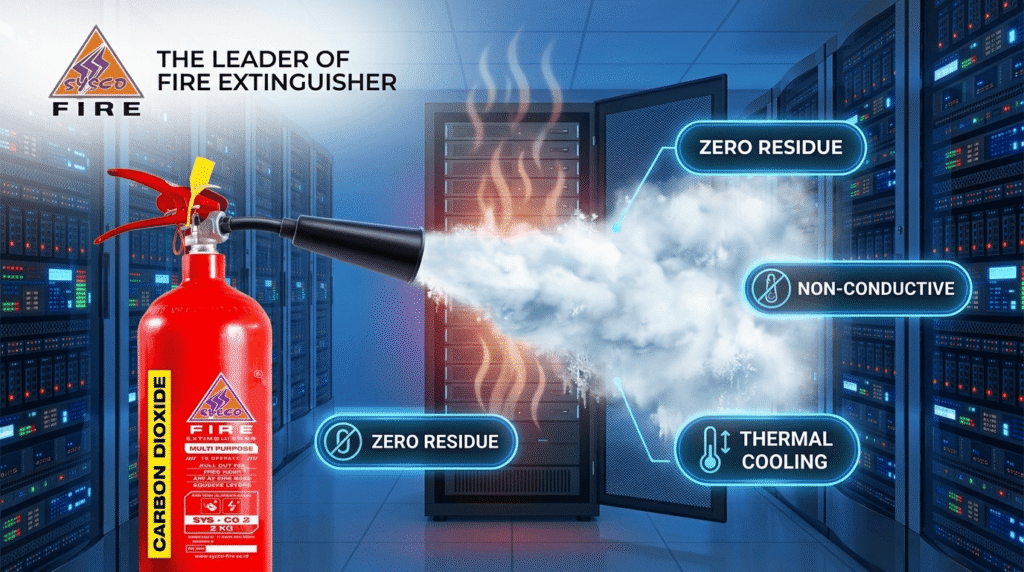
- Thermal Cooling: As liquid CO2 expands into a gas, its temperature drops to approximately -78.5°C (-109.3°F). This sudden thermal plunge rapidly chills overheating electronic components, interrupting thermal runaway.
5 Reasons CO2 Extinguishers Are Mandatory for Electronic Rooms
1. Zero Residue (Clean Agent Fire Suppression)
The most critical advantage of CO2 over conventional extinguishing agents is that it is a clean agent. When CO2 suppresses a fire, it evaporates entirely into the atmosphere, leaving behind zero liquid, zero dust, and zero chemical film.
- The Dry Powder Disaster: Dry chemical powder extinguishers (ABC powder) discharge fine sodium or ammonium phosphate salts. These particles melt on contact with hot electronics, producing a corrosive glaze that ruins microcircuitry, blocks heat sinks, and destroys untouched neighboring servers.
- The CO2 Advantage: Because CO2 leaves no residue, clean equipment located adjacent to the fire remains completely unharmed and operational.
2. Non-Conductive Safety
Water, foam, and certain chemical agents conduct electricity. Attempting to extinguish energized electrical equipment with water creates a severe risk of electrocution for responders and causes massive short-circuiting that escalates the fire.
CO2 is electrically non-conductive. It allows personnel to discharge the extinguisher directly onto energized equipment (up to thousands of volts) without shutting down the entire facility’s main breaker first, saving precious reaction seconds during an emergency.
3. Deep Penetration into Racked Components
Server rooms are filled with narrow enclosures, sub-floor raceways, tightly packed server blades, and ventilated server cabinets. Solid or liquid streams from standard extinguishers cannot reach inside these concealed areas.
Because CO2 releases as a expanding gas, it naturally flows into hard-to-reach crevices, server vents, and cable ducts, suppressing localized fires deep inside equipment chasses where visual inspection is impossible.
4. Thermal Shock Prevention Without Moisture
While cold enough to cool burning components, CO2 is completely moisture-free. Unlike water mist or foam, it does not introduce condensation or fluid build-up inside sensitive microprocessors, memory chips, or storage drives.
5. Drastic Reduction in Business Downtime
For modern enterprises, the cost of equipment destruction is often dwarfed by the cost of operational downtime. Cleaning dry chemical powder from a server room can take days or weeks, often requiring complete room replacement.
With CO2, once the fire is extinguished and the gas dissipates, technicians can immediately replace only the specific damaged unit and bring the rest of the infrastructure back online in hours rather than weeks.
Comparing Fire Extinguisher Types for Server Environments
| Feature | Carbon Dioxide (CO2) | Dry Chemical Powder (ABC) | Water / Foam | Clean Agent (HFC/Novec) |
| Residue Left Behind | None (100% Gas) | Heavy, Corrosive Powder | Liquid Damage | None |
| Electrical Conductivity | Non-Conductive | Non-Conductive | High Risk of Conduction | Non-Conductive |
| Equipment Safety | Maximum Safety | Destroys Electronics | Total Destruction | Maximum Safety |
| Cooling Effect | Very High | Moderate | High | Moderate |
| Penetration Power | Excellent (Gas) | Poor (Line of sight) | Poor | Excellent (Gas) |
| Ideal Primary Use | Server / Control Rooms | Warehouses / Vehicles | Class A (Paper/Wood) | Server Enclosures |
Best Practices for Deploying CO2 Extinguishers in Data Centers
To maximize safety and effectiveness, deploying CO2 fire extinguishers in server rooms requires adhering to specific protocols:
- Strategic Placement: Mount CO2 extinguishers near entrance/exit doors and high-risk zones (such as next to main UPS banks and server racks). Ensure pathways remain unobstructed.
- Proper Sizing & Weight Checks: CO2 cylinders do not have built-in pressure gauges like dry chemical units because CO2 remains liquid under constant vapor pressure. Maintenance must involve weighing the cylinder annually to verify charge levels.
- Personnel Training on Thermal Safety: The discharge horn of a CO2 extinguisher becomes extremely cold during use. Operators should always hold the unit by the insulated handle or grip to avoid frostbite.
- Ventilation Considerations: Because CO2 displaces oxygen, deploying large amounts in confined spaces requires immediate evacuation after discharge to prevent asphyxiation. Ensure server room staff are trained on emergency evacuation procedures.
Conclusion
Protecting a server room or electronic facility requires a balance between fire suppression efficiency and asset preservation. Traditional extinguishing agents may put out the flame, but they routinely cause irreversible secondary damage to high-value infrastructure.
Carbon Dioxide (CO2) fire extinguishers stand as the premier choice for electronic and server environments. By combining non-conductive safety, zero-residue clean operation, and rapid thermal reduction,CO2 units safeguard critical data, preserve expensive hardware, and ensure business continuity when every second counts.
Baca juga : Komponen APAR: 11 Bagian yang Sering Diabaikan, tapi Penting Saat Darurat
Need Premium CO2 & Certified Fire Protection Solutions?
Protect your critical digital infrastructure with certified, high-performance fire extinguishers built to strict safety standards.
For comprehensive information regarding official APAR (Alat Pemadam Api Ringan) manufacturers and industrial fire suppression systems, visit our official website at https://sysco-fire.co.id.
To explore our complete lineup of certified CO2 fire extinguishers and specialized safety equipment, visit our product page at https://sysco-fire.co.id/Promo.
Have questions or need a custom fire safety consultation for your server room? Contact our expert support team directly on WhatsApp at +62852-5711-4711 via https://sysco-fire.co.id/cs. Protect your assets before disaster strikes!