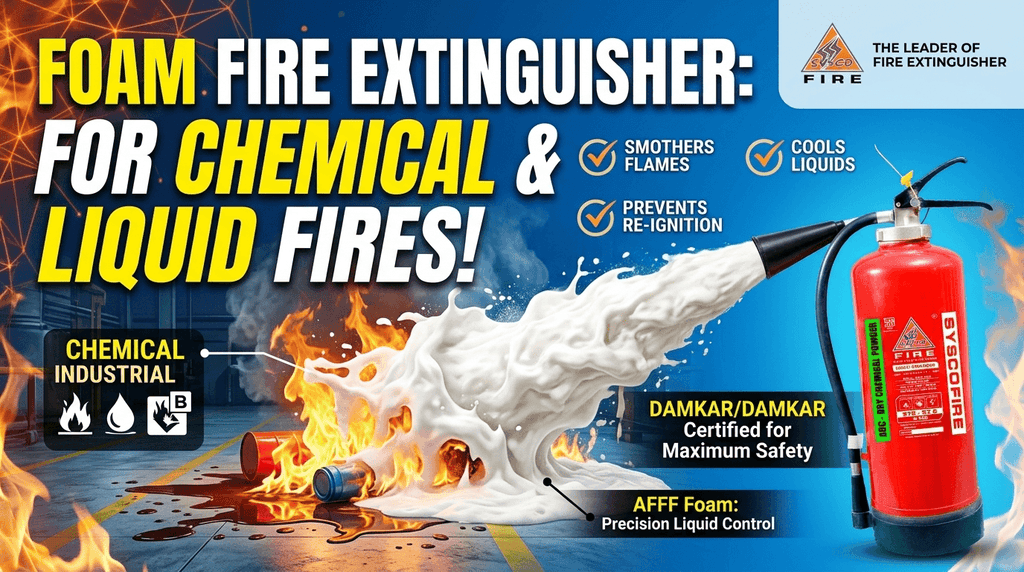
When a fire involves highly flammable liquids—such as gasoline, diesel, industrial solvents, paints, or alcohol—the standard approach to fire suppression must drastically change. Unlike ordinary combustible fires involving wood or paper, liquid fires are highly volatile, prone to rapid spreading, and react violently to incorrect extinguishing methods. This is where the Foam Fire Extinguisher becomes a critical, life-saving asset.
Widely recognized by their distinct color-coding (often a cream or yellow band on the canister, depending on regional safety standards), foam fire extinguishers are purpose-built to tackle some of the most dangerous and unpredictable blazes in industrial, commercial, and automotive settings.
In this comprehensive fire safety guide, we will explore the science behind foam extinguishing agents, why they are the absolute best choice for Class B flammable liquid fires, the severe dangers of using incorrect agents, and the proper techniques for utilizing them safely in an emergency.
Table of Contents
The Science of Suppression: What is a Foam Fire Extinguisher?
A foam fire extinguisher contains a specialized chemical solution primarily made up of water and a foaming agent. The most common and effective type of foam used in modern fire safety is AFFF (Aqueous Film Forming Foam).
When discharged, the extinguisher propels this solution through a specialized nozzle that aerates the liquid, mixing it with surrounding air to create a thick, expansive blanket of chemical foam. This foam is uniquely engineered to be lighter than flammable liquids. Because it has a lower specific gravity than fuels like oil or gasoline, the foam floats on the surface of the burning liquid rather than sinking.
This floating characteristic allows the foam extinguisher to attack the fire through two simultaneous mechanisms:
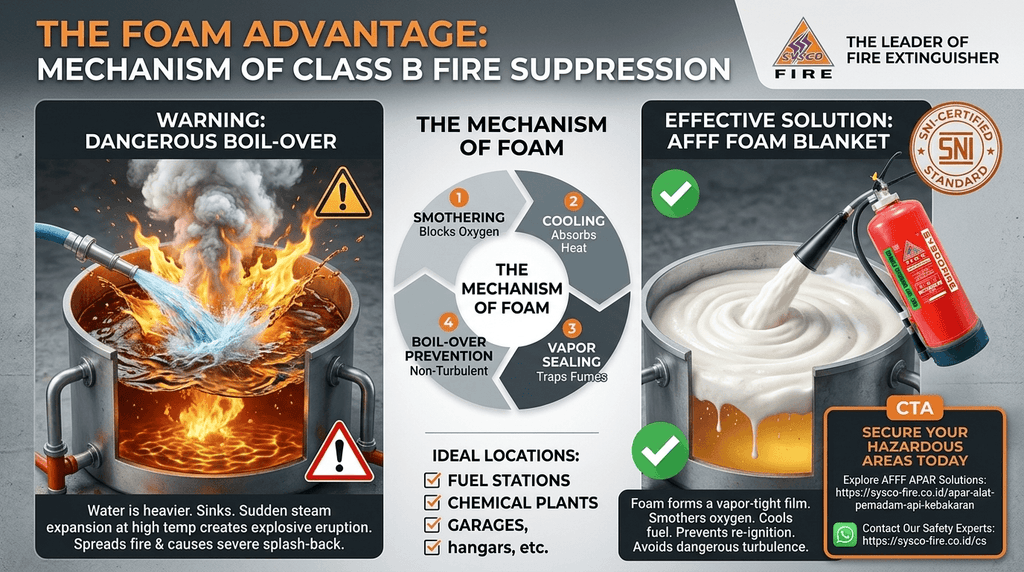
- The Smothering Effect (Oxygen Deprivation): The primary mechanism of the fire tetrahedron (heat, fuel, oxygen, chemical reaction) attacked by foam is oxygen. The thick layer of foam creates an impenetrable barrier across the surface of the liquid pool, completely sealing off the fuel from the oxygen in the ambient air. Without oxygen, the chemical reaction of the fire rapidly collapses.
- The Cooling Effect (Thermal Reduction): Because AFFF foam is predominantly water-based, it carries excellent heat-absorbing properties. As the foam blanket spreads over the burning liquid and surrounding surfaces, the water content absorbs the immense heat, lowering the temperature of the fuel below its ignition point.
- Vapor Suppression (Preventing Re-ignition): Flammable liquids do not actually burn in their liquid state; it is the invisible vapors evaporating off the liquid’s surface that ignite. The aqueous film formed by the foam completely seals the surface, trapping these volatile vapors and ensuring the fire cannot reignite even after the initial flames are knocked down.
Understanding Fire Classifications: Where Foam Excels
To ensure workplace and environmental safety, it is vital to deploy the correct extinguisher for specific hazard zones. Foam fire extinguishers are highly rated for two specific fire classes:
- Class A Fires (Solid Combustibles): These involve ordinary materials like wood, paper, textiles, and plastics. The high water content in the foam makes it highly effective at cooling these solid materials and penetrating embers to prevent rekindling.
- Class B Fires (Flammable Liquids): This is where foam truly dominates. Class B fires involve petrol, diesel, aviation fuel, paint thinners, cleaning solvents, and lubricating oils. Foam is explicitly engineered to tackle the unique physics of these liquid-based infernos.
Crucial Warning: Standard foam extinguishers are not safe for Class C (electrical) fires because their high water content makes them electrically conductive, which can cause severe shock hazards. They are also inappropriate for Class F/K (cooking oil/fat) fires, where specialized wet chemical agents are required.
The Catastrophic Danger of Using Water on Liquid Fires
A common and highly dangerous misconception is that throwing a bucket of water or using a standard Water APAR on a chemical or fuel fire will extinguish it. Doing so can turn a manageable emergency into a catastrophic explosion.
If you spray water onto burning oil or gasoline, two disastrous things happen. First, water is heavier than most flammable liquids. The water instantly sinks below the burning fuel. Second, due to the intense heat of the fire, the sunken water instantly boils and turns into steam. Steam expands to roughly 1,700 times the volume of liquid water in a fraction of a second.
This rapid expansion creates a violent eruption, blasting the burning, boiling oil in all directions. This phenomenon, known as a “boil-over” or splash-back, spreads the fire rapidly across the room and causes severe, life-threatening burns to anyone nearby. By utilizing a foam fire extinguisher, you completely bypass this risk. The foam gently floats on top of the fuel, locking in the danger without causing explosive turbulence.
Proper Application Technique: How to Use a Foam Extinguisher
Using a foam extinguisher on a liquid fire requires a specific technique. If you spray the pressurized foam directly into the center of the liquid pool, the force of the jet can splash the burning fuel out of its container and spread the fire.
To maximize safety and effectiveness, follow the Lobbing or Bouncing Technique:
- Assess the Environment: Ensure you have a clear, unobstructed path to an exit before attempting to fight the fire.
- Pull the Pin: Break the tamper seal and remove the safety pin from the handle.
- Aim at a Vertical Surface: If the flammable liquid is contained within a barrel, tank, or walled area, do not aim directly at the liquid. Instead, aim the nozzle at the inside back wall of the container, just above the burning liquid.
- Squeeze and Let it Settle: Squeeze the operating lever to discharge the foam. By hitting the vertical surface, the foam will gently slide down the wall and gracefully spread across the surface of the liquid, forming the necessary blanket without splashing the fuel.
- The “Falling Snow” Method: If the fire is an open spill on flat ground with no vertical surfaces nearby, aim the nozzle high into the air above the fire and wave it gently side to side, allowing the foam to fall softly onto the liquid pool like snow.
- Do Not Walk Through the Foam: Once the fire is out, never step into or disturb the foam blanket. Breaking the chemical seal can release trapped flammable vapors, causing an immediate and violent re-ignition.
Ideal Locations for Foam Fire Extinguisher Installation
Because of its specialized liquid-smothering capabilities, Foam APARs are mandatory for environments where liquid chemicals and hydrocarbon fuels are stored, processed, or transferred. Facility managers should prioritize placing foam extinguishers in:
- Fuel Stations and Refineries: Areas handling vast quantities of gasoline, diesel, and aviation fuel.
- Manufacturing Plants and Workshops: Spaces utilizing industrial solvents, chemical cleaners, lubricants, and flammable adhesives.
- Warehouses and Storage Facilities: Zones designated for the bulk storage of paints, thinners, and chemical drums.
- Aviation Hangars and Auto Garages: Environments where vehicles and aircraft are serviced, repaired, and refueled.
Conclusion: Prioritizing Chemical Fire Safety
Flammable liquid fires present one of the most volatile and fast-moving threats to any commercial or industrial facility. Standard fire suppression methods are not just ineffective against these chemical blazes—they are actively dangerous. The Foam Fire Extinguisher stands as a masterpiece of chemical engineering, combining the cooling properties of water with an advanced smothering blanket that instantly neutralizes toxic vapors and starves the fire of oxygen. By equipping your hazardous workspaces with certified AFFF foam extinguishers and training your personnel in proper application techniques, you establish an impenetrable line of defense against catastrophic chemical fires.
Baca juga:Tempat Beli APAR Jakarta: 11 Panduan Memilih Supplier untuk Kebutuhan K3 .
Equip Your Facility with Certified Fire Safety Solutions
Never compromise when it comes to industrial and chemical fire safety. Ensure your workplace is fully protected with premium, SNI-certified Foam Fire Extinguishers engineered for rapid response and maximum reliability.
- Explore Comprehensive Fire Safety Systems: Visit our official manufacturer website at https://sysco-fire.co.id to learn more about our industry-leading safety engineering.
- Browse Our APAR Catalog: Find the exact foam, dry chemical, or clean agent extinguisher for your facility’s unique risk profile at https://sysco-fire.co.id/apar-alat-pemadam-api-kebakaran.
- Get Expert Consultation Today: Need help calculating your facility’s specific fire extinguisher requirements? Our safety specialists are ready to assist you. Contact us directly via WhatsApp at +62 852-5711-4711 by clicking here: https://sysco-fire.co.id/cs.