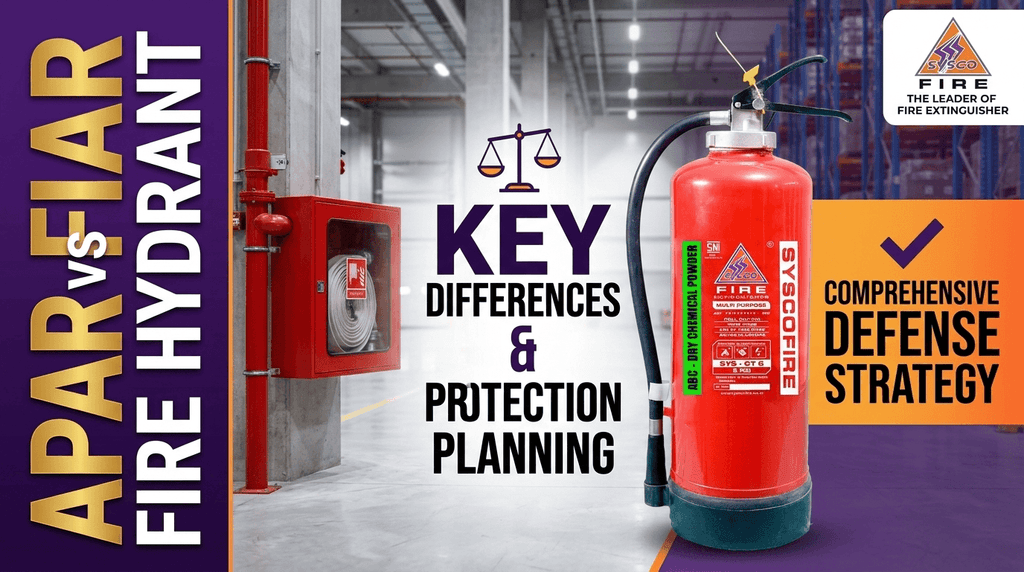
When designing an active fire protection framework for industrial facilities, commercial high-rises, warehouses, or public institutions, facility managers and safety engineers encounter two fundamental defense pillars: Portable Fire Extinguishers (APAR – Alat Pemadam Api Ringan) and Fire Hydrant Systems.
While both systems share the ultimate goal of protecting property, securing business continuity, and safeguarding human life, they operate on completely different scales, engineering parameters, and operational timelines. Confusing the distinct roles of APAR units and fire hydrants—or relying exclusively on one over the other—exposes a facility to massive regulatory penalties, excessive property loss, and catastrophic safety vulnerabilities.
This comprehensive guide breaks down the key technical differences between APAR vs Fire Hydrant Systems, evaluates their complementary roles in multi-tiered safety planning, and explains how to build an integrated protection strategy that strictly complies with Indonesian K3 and Permenaker safety standards.
Table of Contents
Understanding the Core Concepts
To plan an effective active fire defense strategy, facility managers must first understand the primary operational purpose of each system.
What is an APAR (Portable Fire Extinguisher)?
An APAR is a self-contained, highly localized, pressure vessel filled with a specific extinguishing agent (such as ABC Dry Chemical Powder, Carbon Dioxide CO2 , AFFF Foam, or Clean Agent). APAR units are portable, hand-operated, and engineered specifically for first-response fire suppression during the initial ignition phase (the “incipient stage”).
What is a Fire Hydrant System?
A Fire Hydrant System is a permanent, fixed water-based suppression infrastructure consisting of main water reservoirs, electric/diesel fire pumps, pressure jockey pumps, piping networks, pillar hydrants, landing valves, hose reels, and fire department connection breeching inlets. It is engineered to deliver continuous, high-volume, high-pressure water streams to fight developed, large-scale fires.
Key Differences: APAR vs Fire Hydrant System
Analyzing these two systems across critical engineering parameters highlights why they are non-interchangeable components of a complete facility defense strategy:
| Technical Parameter | APAR (Portable Fire Extinguisher) | Fire Hydrant System |
| Primary Fire Stage Target | Incipient Stage (First 0 to 3 minutes) | Fully Developed / Advanced Stage Fires |
| Agent / Suppressing Medium | Chemical Powder, CO2 , AFFF Foam, Clean Gas | Continuous High-Pressure Water Supply |
| Operation & Portability | Handheld, mobile, operable by single person | Fixed piping, requires trained fire brigade/teams |
| Discharge Duration | 10 to 30 seconds per cylinder | Continuous (Dependent on water tank capacity) |
| Coverage Area | Localized hazard zone (<15m travel distance) | Whole facility footprint / multi-zone perimeter |
| Installation Complexity | Low (Wall mounting brackets, cabinets) | High (Civil piping, pump rooms, water tanks) |
| Regulatory Benchmark | Permenaker No. 04/1980 & SNI Standards | SNI 03-1745-2000 & NFPA 14 Standards |
Detailed Comparison Breakdown
1. Fire Stage and Suppression Mechanism
- APAR (First-Line Defense): Fires begin small. When a short circuit ignites office equipment or a spark catches oil-soaked rags, a nearby APAR provides instantaneous suppression. Squeezing the valve discharges the chemical agent directly onto the combustion source, snuffing out flames before room flashover occurs.
- Fire Hydrant (Heavy Duty Defense): If an incipient fire is not controlled within the first few minutes, heat and flames spread rapidly beyond the capacity of handheld cylinders. Fire hydrants supply hundreds of gallons of water per minute under high bar pressure, allowing internal emergency response teams or public firefighters to cool surrounding structures, prevent thermal collapse, and extinguish major infernos.
2. Operational Manpower and Response Speed
- APAR Deployment: Requires zero setup time. Any staff member trained in the basic PASS method (Pull, Aim, Squeeze, Sweep) can grab a wall-mounted cylinder and initiate discharge within seconds.
- Hydrant Deployment: Requires organized team coordination. Operators must unroll heavy synthetic canvas hoses, couple hose nozzles to landing valves, open valve handwheels, charge pressurized water lines, and brace against extreme back-pressure during discharge.
3. Agent Suitability and Collateral Risk
- Extinguishing Agents in APARs: Offer specialized chemical versatility. For example, $CO_2$ or Clean Agent APARs safely suppress fires in server rooms and electrical control panels without causing moisture or chemical residue damage.
- Water Supply in Hydrants: Water is the most effective medium for cooling large Class A structural fires, but conducting high-pressure water streams into energized electrical gear or chemical storage creates severe electrocution and hazardous chemical runoff risks unless power is isolated first.
Comprehensive Protection Planning: The Layered Safety Strategy
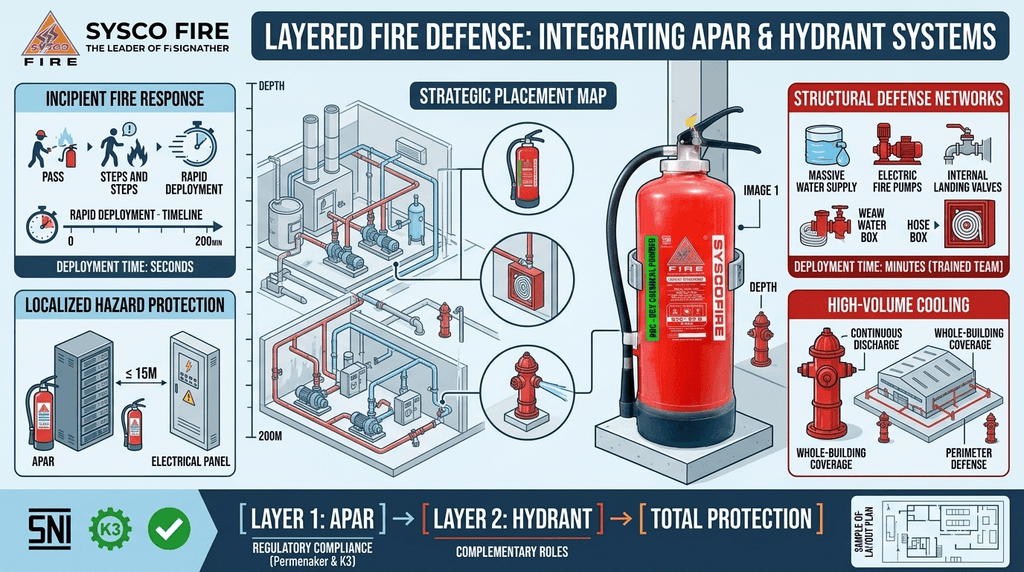
A modern commercial building, manufacturing plant, or logistics hub must never choose between APARs and hydrants; instead, safety engineering requires a multi-tiered, layered protection strategy:
[Layer 1: Early Detection] -> Smoke / Heat Detectors & Fire Alarm System
[Layer 2: Incipient Suppression] -> Strategically Placed APAR Units (Dry Powder, CO2, Foam)
[Layer 3: Structural Defense] -> Fire Hydrant Systems & Automatic Fire Sprinklers
[Layer 4: External Support] -> Fire Department Connection (Siamese Connection)
1. Calculating APAR Density
Install portable APAR units at key hazard zones, along main exit corridors, near electrical panels, and near exit stairwells. Ensure that the maximum travel distance from any floor point to an APAR does not exceed 15 meters, complying with Permenaker 04/1980.
2. Positioning Hydrant Pillars and Hose Boxes
Position outdoor pillar hydrants around the building perimeter to allow fire trucks clear access. Install indoor hydrant hose boxes near emergency exit staircases so response teams can attach 1.5-inch or 2.5-inch hoses quickly without blocking evacuation routes.
3. Maintenance and Inspection Synchronization
Both systems require strict periodic maintenance:
- APAR Maintenance: Monthly pressure gauge inspections (verifying the needle remains in the Green Zone), periodic cylinder inversion to prevent powder caking, and annual professional refilling.
- Hydrant Maintenance: Weekly jockey pump pressure tests, monthly diesel pump test runs, annual hose flow tests, and routine inspection of landing valve rubber seals.
Why Choose Sysco Fire for Integrated Safety Planning
As a recognized leader in fire engineering and certified equipment manufacturing, Sysco Fire offers complete active protection solutions tailored for commercial, industrial, and institutional applications:
- Factory-Certified APAR Production: Every Sysco Fire cylinder is manufactured strictly to Indonesian National Standards (SNI) and Permenaker compliance rules, ensuring fail-safe reliability during incipient fire emergencies.
- Versatile Agent Selection: We manufacture high-grade ABC Dry Chemical Powder, Carbon Dioxide (CO2), AFFF Foam, and Clean Agent APAR units ranging from 1 kg portable cylinders to 80 kg heavy industrial trolley units.
- Comprehensive Technical Support: Our experienced team assists facility managers in auditing building hazard zones, planning compliant APAR placement maps, and selecting the right fire suppression equipment for total risk coverage.
Conclusion
Understanding the key differences between APAR vs Fire Hydrant Systems is the foundation of effective facility safety planning. APAR portable extinguishers provide critical, immediate fire knockdown during the first seconds of an outbreak, while fire hydrant networks deliver heavy-duty structural defense against major, developed fires. Integrating both systems through certified equipment selection, compliant installation, and routine maintenance guarantees total asset protection and workforce safety.
Ensure your facility is fully protected, compliant, and emergency-ready. Partner with certified fire protection experts.
Baca juga : Jangan Anggap Sepele! 11 SOP K3 Puskesmas yang Wajib Dipahami Tenaga Kesehatan.
Explore Our Official Catalog and Connect with Our Experts
Ready to optimize your facility’s fire safety infrastructure with certified APAR units and expert engineering advice? Explore our manufacturing lineup and speak with our technical team today.
- Visit Our Official Website: Discover our full range of fire engineering credentials, manufacturing standards, and corporate expertise at https://sysco-fire.co.id.
- Browse Our Full Product Catalog: View detailed specifications, capacities, and agent types for Dry Chemical Powder, CO2, Foam, and Clean Agent APARs on our official product page at https://sysco-fire.co.id/Promo.
- Speak With Our Safety Consultants: Need assistance designing an integrated fire protection plan or requesting a wholesale procurement quote? Contact our customer support team via WhatsApp at +62 852-5711-4711 or click here to connect directly through our official service desk: https://sysco-fire.co.id/cs.