
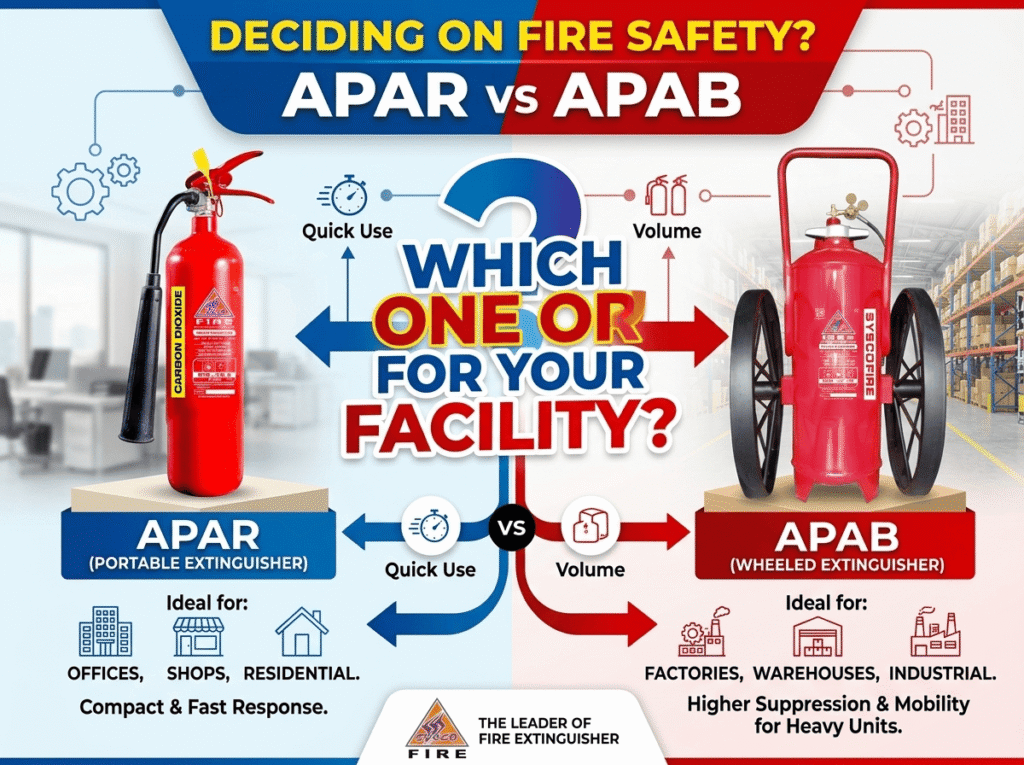
When it comes to safeguarding a commercial building, industrial facility, or even a residential complex from fire hazards, one of the most critical decisions safety managers face is selecting the appropriate fire suppression equipment. In the realm of fire safety, particularly in Southeast Asia and Indonesia, you will frequently encounter two essential terms: APAR (Portable Fire Extinguisher) and APAB (Heavy Fire Extinguisher).
While both serve the ultimate goal of extinguishing fires and saving lives, they are engineered for vastly different scenarios, hazard levels, and operational requirements. Relying solely on small portable units in a high-risk industrial plant is a recipe for disaster, just as deploying massive wheeled units in a cramped office space is highly impractical.
In this comprehensive guide, we will break down the fundamental differences between APAR (Portable Fire Extinguishers) and APAB (Wheeled Fire Extinguishers), explore their unique capabilities, and provide an expert framework to help you determine exactly which type of equipment your facility needs to maintain optimal safety and regulatory compliance.
Table of Contents
Understanding APAR (Portable Fire Extinguisher)
APAR translates to “Light Fire Extinguisher,” universally known as the standard Portable Fire Extinguisher. These are the familiar, handheld red cylinders you see mounted on walls, tucked into cabinets, or placed in vehicle trunks.
Key Characteristics of APAR
APAR units are designed as the first line of defense against incipient-stage fires—fires that have just ignited and are still localized to a small area.
- Weight and Capacity: Typically, APAR units range in capacity from as small as
 (ideal for personal vehicles) up to or
  (standard for commercial corridors). Because of their weight, they are designed to be easily lifted and carried by a single person, regardless of their physical strength.
 - Operation: They are highly user-friendly. Most adults can operate an APAR with minimal training using the universal P.A.S.S. method: Pull the pin, Aim at the base of the fire, Squeeze the lever, and Sweep side to side.
- Discharge Time: Due to their smaller capacity, portable extinguishers usually have a rapid discharge time, emptying their contents in roughly 10 to 25 seconds, depending on the size and type of agent.
- Common Agents: APAR units are available in all major fire-suppressing agents, including ABC Dry Chemical Powder, Carbon Dioxide (
 ), AFFF Foam, and Clean Agents (gases).
Understanding APAB (Heavy Fire Extinguisher)
APAB translates to “Heavy Fire Extinguisher,” globally referred to as a Wheeled Fire Extinguisher or Mobile Fire Extinguisher. When a facility houses high-hazard materials or expansive open areas, a handheld unit simply does not carry enough suppression power. This is where the APAB steps in, bridging the gap between a portable extinguisher and a full-scale fire engine response.
Key Characteristics of APAB
APAB units are massive, high-capacity cylinders mounted on a specialized carriage or trolley with heavy-duty wheels.
- Weight and Capacity: APAB capacities generally start at and can go all the way up to
 or more. Because the total weight of the unit (cylinder, agent, and carriage) can easily exceed , it cannot be carried.
 - Operation: While they can be operated by a single trained individual, they are often more effectively managed by two people—one to maneuver the trolley and open the main cylinder valve, and the other to uncoil the long hose and direct the nozzle at the fire.
- Discharge Time and Range: An APAB provides a massive volume of extinguishing agent, allowing for a continuous discharge time that can last from 40 seconds to over a minute. Furthermore, they feature extended hoses (often
 long) and a much higher discharge pressure, allowing the operator to stand much farther away from the intense heat of a large fire.
 - Common Agents: Like portable units, wheeled extinguishers are available in Dry Chemical Powder, , and Foam, but are specifically formulated to knock down large-scale Class A, B, and C fires rapidly.
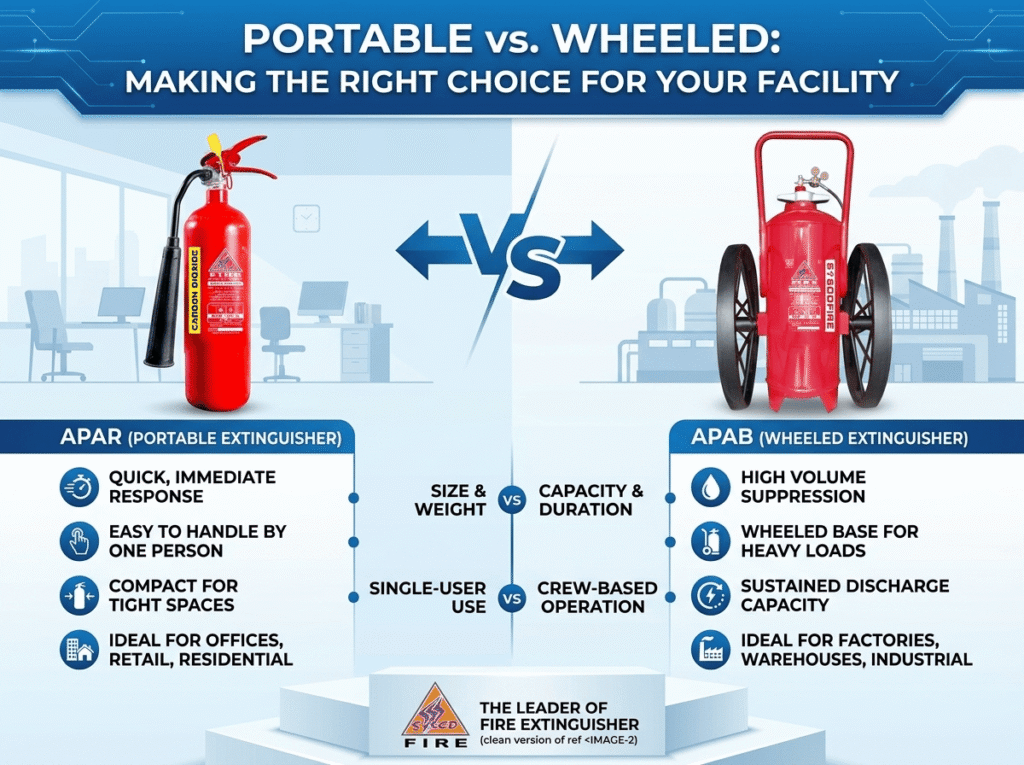
The Core Differences: A Side-by-Side Comparison
To clearly understand which unit suits your facility, let’s compare them across four critical operational metrics:
1. Mobility and Deployment Speed
- APAR: Unmatched in deployment speed. You can grab an APAR off a wall hook and run up a flight of stairs or navigate through narrow office cubicles in seconds.
- APAB: Slower to deploy. Moving a heavy wheeled unit requires flat ground, wide aisles, and ramps. They cannot be quickly moved up stairs without an elevator, making them unsuitable for multi-story office buildings lacking freight transport.
2. Suppression Power and Volume
- APAR: Designed for fires the size of a trash can or a single desk. Once the of powder is gone, if the fire is not out, the operator must evacuate.
- APAB: Designed for substantial fires, such as a ruptured fuel line, a burning forklift, or a massive chemical spill. A wheeled unit delivers nearly ten times the firefighting power of a standard wall-mounted unit, capable of smothering large surface-area fires before they consume a building.
3. Operator Safety Margin
- APAR: The operator must get relatively close to the flames (usually within
 ) to ensure the agent reaches the base of the fire.
 - APAB: The extended hose and high-pressure nozzle allow the operator to combat the fire from a significantly safer distance, protecting them from radiant heat, toxic smoke, and potential secondary explosions.
How to Determine What Your Facility Needs
Choosing between APAR and APAB is not a matter of preference; it is a matter of strict hazard assessment and facility layout. Here is an expert framework to guide your decision:
Scenario A: You Need APAR (Portable Extinguishers) Only
If your facility falls under Light (Low) to Ordinary Hazard classifications, portable units are typically sufficient.
- Ideal Locations: Corporate office buildings, schools and universities, retail boutiques, hotels, residential apartment complexes, and standard commercial kitchens.
- The Strategy: Distribute to APAR units strategically along exit routes, near electrical panels, and close to specific minor hazards (like a breakroom stove) ensuring travel distance to any extinguisher does not exceed standard safety regulations (usually
 ).
).
Scenario B: You Need APAB (Wheeled Extinguishers)
If your facility is classified as an Extra (High) Hazard environment, relying solely on portable units is a severe safety violation. You must incorporate APAB units into your fire safety master plan.
- Ideal Locations: Oil and gas refineries, chemical manufacturing plants, aviation hangars, large-scale logistics warehouses with high-pile racking, shipyards, heavy equipment depots, and loading docks handling flammable liquids (Class B hazards).
- The Strategy: Place APAB units in highly visible, easily accessible locations on the ground floor with clear, unobstructed aisles. They should be positioned near the highest-risk areas, such as bulk fuel storage tanks or heavy manufacturing machinery.
Scenario C: The Hybrid Approach (Most Common for Industry)
In most medium-to-large industrial settings, the safest and most compliant strategy is a combination of both.
- Use APAR units every few meters to handle sudden, small emergencies (e.g., a small electrical short in a control room).
- Use APAB units stationed in the main production halls or fuel bays as the heavy artillery to handle catastrophic flare-ups that a portable unit cannot contain.
Conclusion
Fire safety is an uncompromising science. The choice between an APAR and an APAB fundamentally dictates your facility’s ability to survive a sudden emergency. APAR units are the agile, fast-responders necessary for everyday small-scale risks found in offices and retail spaces. Conversely, APAB units are the heavy-duty powerhouses essential for protecting industrial complexes, warehouses, and high-hazard zones from devastating losses. By accurately assessing your facility’s spatial layout, hazard classifications, and potential fire sizes, you can deploy the right equipment to ensure the ultimate safety of your personnel and assets.
Baca juga : SOP APAR Klinik: 11 Hal yang Wajib Dicek agar Alat Pemadam Selalu Siap Digunakan.
Secure Your Facility with Sysco Fire
Whether you need agile portable extinguishers for your new office layout or heavy-duty wheeled units to protect a sprawling industrial warehouse, you need equipment you can trust in the crucial moment.
For industry-leading, certified fire protection solutions, visit the official https://sysco-fire.co.id.
Explore our comprehensive catalog of both premium APAR (Portable) and APAB (Wheeled) units engineered for maximum reliability at our https://sysco-fire.co.id/Promo .
Unsure about what your specific facility requires? Let our certified safety experts conduct a consultation and help you plan your fire defense strategy. Contact our engineering and sales team today via WhatsApp at +62852-5711-4711 for a professional assessment and competitive quotation.