
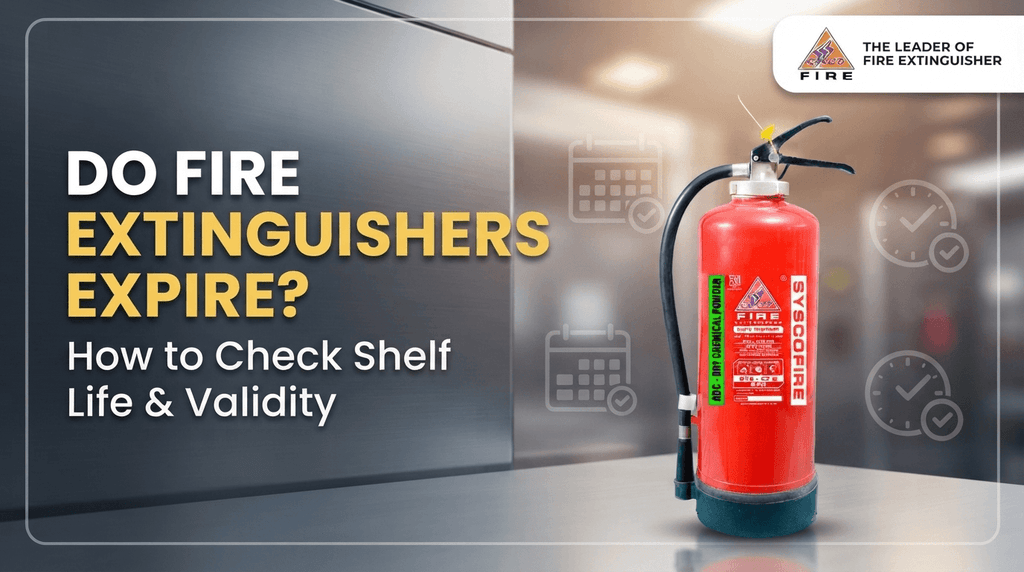
A fire extinguisher is like an insurance policy: you hang it on the wall hoping you never have to use it. But unlike an insurance policy, you cannot simply renew it with a phone call. Because it is a mechanical device containing chemical agents under intense pressure, its reliability degrades over time.
This leads to one of the most critical questions in fire safety: Do fire extinguishers expire?
The short answer is: Yes and No. While many modern fire extinguishers do not have a specific “expiration date” stamped on them like a carton of milk, they absolutely have a limited functional shelf life. They become less effective, lose pressure, or their chemical agents “cake” inside the cylinder, rendering them useless in an emergency.
As fire safety specialists, we are here to provide an authoritative, expert guide on how to determine if your portable fire extinguisher (often referred to in Indonesia as APAR – Alat Pemadam Api Ringan) is still valid, how to read manufacturer dates, and how to maintain compliance to ensure your property and loved ones are protected.
Table of Contents
Why Fire Extinguishers Fail: The Mechanics of Aging
To understand why a validity period matters, we must understand what happens inside that red cylinder over time. A fire extinguisher is a pressurized vessel designed to forcefully expel an extinguishing agent.
Several factors degrade this capability:
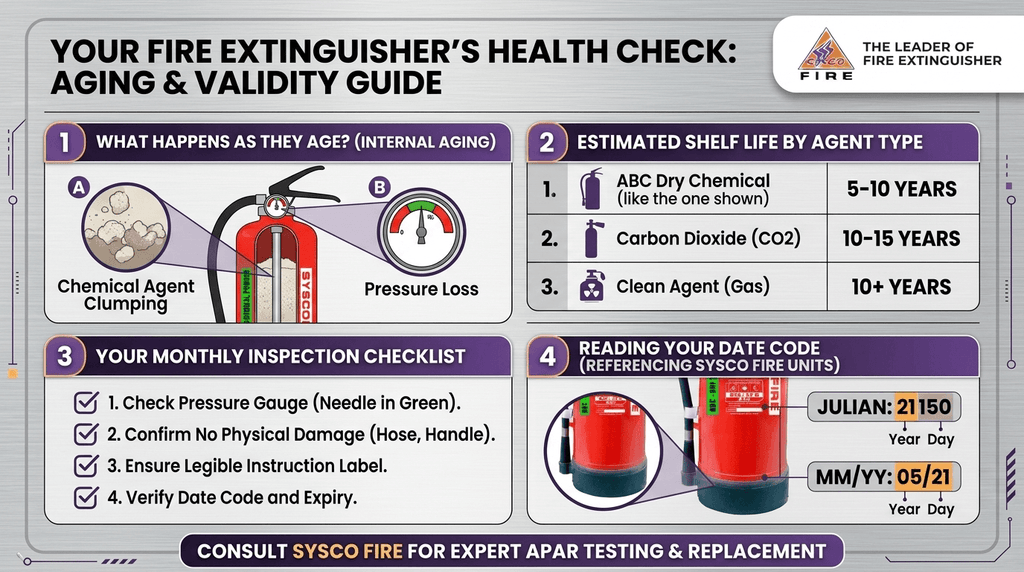
- Loss of Pressure: Extinguishers rely on a propellant gas (often nitrogen or carbon dioxide) to force the agent out. Over years, tiny microscopic leaks can occur through seals, the valve assembly, or the pressure gauge fitting. Once pressure drops below a certain threshold, the extinguisher cannot expel the agent effectively.
- Chemical Degradation: Different agents behave differently.
- Dry Chemical Powder: This is the most common type. Over time, particularly when exposed to vibration (in a vehicle) or temperature fluctuations, the moisture-attracting powder can clump together at the bottom of the cylinder. This is known as “caking.” When you pull the pin, the gas will escape, but the hard powder remains stuck inside.
- Foam (AFFF): Foam agents are liquid solutions that can eventually separate or break down chemically, losing their ability to suppress vapors and smother flames.
- CO2 and Clean Agents: These are gases. They generally don’t “spoil,” but they are the most prone to gradual pressure loss.
- Physical Corrosion: The cylinder itself can corrode, especially in humid tropical climates like Indonesia or when installed near coastal areas. A corroded cylinder is a safety hazard because it can no longer withstand the high internal pressure.
Estimated Shelf Life by Fire Extinguisher Type
While inspections are the true determinant of validity, manufacturers provide general guidelines for how long an extinguisher is expected to remain reliable under normal conditions. In fire safety regulations and best practices, these are the standard lifespans for APAR:
1. Dry Chemical Powder APAR (ABC Powder)
These are the most versatile units used in homes, offices, and vehicles.
- Estimated Shelf Life: 5 to 10 years.
- Expert Note: Although they can last 10 years, they require significant mandatory maintenance (hydrostatic testing and internal inspection) mid-way through that life.
2. Carbon Dioxide (CO2) APAR
Primarily used for electrical fires (Class E) and flammable liquid fires (Class B).
- Estimated Shelf Life: 10 to 15 years.
- Expert Note: CO2 cylinders are under incredibly high pressure. Their longevity depends heavily on the integrity of the cylinder itself rather than the gas.
3. Foam (AFFF) APAR
Best suited for flammable liquid fires (Class B).
- Estimated Shelf Life: 5 years.
- Expert Note: Foam is liquid-based and degrades faster chemically than powders or gases.
4. Clean Agent (Halotron/HFC) APAR
Zero-residue alternatives used for sensitive electronics or server rooms.
- Estimated Shelf Life: 10 to 12 years.
It is critical to remember that these are estimates. An unmaintained 3-year-old extinguisher can fail, while a perfectly maintained 12-year-old extinguisher might still work (provided it passes regulatory testing).
How to Check Validity and Read Manufacture Dates
To know if your fire extinguisher is approaching its end of life, you must know how old it is. Most portable fire extinguishers do not list an expiration date; they list the manufacture date. You then calculate the validity based on the type.
Here is how to locate and read this information:
Step 1: Locating the Date Stamp or Serial Label
Look closely at the following areas on the cylinder:
- Stamped into the metal rim: For CO2 extinguishers or high-quality steel cylinders, the date is often stamped directly into the bottom rim of the cylinder or on the “shoulder” (the curved metal top near the valve).
- On the Manufacturer’s Label: Look at the main printed label. The year of manufacture may be printed in a small box near the serial number.
- Stamped on the bottom: Many aluminum or smaller residential extinguishers have the date stamped on the very bottom of the unit.
Step 2: Reading the Date Code
Manufacturers use different formats. Usually, they are easy to decipher, but sometimes they are coded. Look for formats like:
- YYYY: (e.g., 2021). Simple and direct.
- MM/YY or MM/YYYY: (e.g., 05/22 or 05/2022). Manufactured in May 2022.
- DD/MM/YY: Standard format outside the US.
- Julian Date Code (Coded): Some may use a Julian code (e.g., 22150). The first two digits are the year (2022), and the last three digits are the day of the year (the 150th day, or May 30th).
If you cannot locate the manufacture date, and the extinguisher came without documentation, treat it as expired and replace it immediately.
Regulatory Compliance & Mandatory Testing (Indonesia)
In Indonesia, portable fire safety equipment (APAR) is regulated by the Ministry of Manpower (e.g., Permenaker No. Per-04/MEN/1980) and standards established by Damkar (Fire Department). You cannot rely solely on the manufacture date stamped on the cylinder to ensure compliance and safety. Mandatory testing intervals must be followed.
Hydrostatic Testing
A hydrostatic test is a mandatory safety procedure where the cylinder is filled with water (rather than gas) and pressurized beyond its normal rating to check for leaks, structural weaknesses, or cylinder expansion.
- Dry Chemical and Foam: Mandatory every 5 years (In many standards, this is when the agent is also refilled/replaced).
- CO2 and Clean Agents: Mandatory every 5 or 12 years, depending on the specific regulatory standard being followed.
Failure to perform hydrostatic testing at the mandatory interval invalidates the extinguisher’s safety certification and renders it legally non-compliant for commercial buildings.
Regular Inspections
Even if the manufacture date is recent, you must perform regular checks. If you observe any of the following during a monthly visual inspection, the validity is gone, and the unit must be replaced or serviced immediately:
- Pressure Gauge in the Red: If the needle is not in the green “Charged” zone, it is unserviceable.
- Corrosion or Rust: Pitting or rust on the metal body.
- Damaged Components: Cracked or blocked hose, missing safety pin, broken tamper seal, or a damaged nozzle.
- Legibility: Missing or unreadable instructions/labels.
Trust Only Certified Fire Safety Professionals
Fire protection is not a DIY project. Your safety depends on equipment engineered by experts and maintained according to strict standards.
As a leading producer and specialist in portable fire extinguishers in Indonesia, Sysco Fire guarantees that every APAR we manufacture meets or exceeds Indonesian SNI and international quality standards. We combine rigorous engineering experience with certified expertise to ensure that when you pull that pin, our equipment works.
Conclusion
Fire extinguishers do degrade over time. Their functional validity is limited by pressure loss, chemical clumping, and physical corrosion. As a general safety guideline, consider the shelf life of dry chemical powder units to be 5–10 years and CO2 units 10–15 years—provided mandatory hydrostatic testing is performed at the required intervals.
To check the validity of your extinguisher, locate the manufacture date stamped on the cylinder shoulder, rim, bottom, or printed on the serial label. If the extinguisher is beyond the mandatory testing cycle or shows signs of corrosion, damage, or pressure loss, it has effectively expired.
Don’t gamble with fire safety. Ensure your home, office, or factory is equipped with reliable, fully certified APAR solutions.
Baca juga : Metode APAR TATS K3: 4 Langkah Praktis Menggunakan APAR dengan Aman dan Tepat.
Contact Indonesia’s Fire Protection Leaders Today
- Explore Certified Fire Safety Engineering: For more information on specialized fire protection systems, manufacture processes, and comprehensive safety expertise, visit Indonesia’s fire protection specialist official website at https://sysco-fire.co.id.
- Detailed APAR Solutions: View our complete catalog of Dry Chemical Powder, Foam, CO2, and Clean Agent extinguishers at https://sysco-fire.co.id/apar-alat-pemadam-api-kebakaran.
- Expert Safety Consultation: Speak directly with our certified fire safety engineering team for guidance on your specific needs, maintenance schedules, or large-scale procurement. Contact us via WhatsApp at +62 852-5711-4711 or click here to redirect directly to our customer service channel: https://sysco-fire.co.id/cs.
Your Safety is Our Expertise. Choose Sysco Fire.