In the world of fire safety, one size does not fit all. Different types of fuel require specialized tools to extinguish them safely. If you attempt to use the wrong fire extinguisher on a specific hazard, you may not only fail to put out the fire but actually make the situation catastrophic.
While Dry Chemical Powder extinguishers are popular for their “all-purpose” label, they often fail to tackle flammable liquid fires properly because they lack one crucial ability: cooling and persistent vapor suppression.
This is where the specialized, reliable Foam Fire Extinguisher (often referred to as AFFF – Aqueous Film Forming Foam) proves its undeniable superiority.
If your environment—whether industrial, commercial, or residential—stores quantities of gasoline, diesel, paints, solvents, or alcohols, understanding the mechanism, application, and expertise behind foam extinguishers is critical.
In this comprehensive guide, we, as fire engineering specialists, will explore the unique chemistry of fire-fighting foam, fire classifications, specific applications, and crucial technical advice on selection and maintenance to ensure you have maximum protection against volatile chemical and fuel fires.
Table of Contents
The Unique Chemistry: How Fire-Fighting Foam Actually Works
Normal water sinks below hydrocarbons (fuel/oil). When you add normal water to a burning oil puddle, the oil floats to the top, remains exposed to oxygen, and the intense heat vaporizes the water instantly, leading to an explosive splattering of burning liquid.
Foam fire extinguishers, however, combat this specific physical reaction through a specialized mechanism known as Vapor Suppression.
Fire-fighting foam solutions (AFFF) consists of specialized fluorochemical surfactants mixed with water and propelled by pressurized gas. When discharged, this solution combines with air at the nozzle, forming a dynamic “foam blanket.”
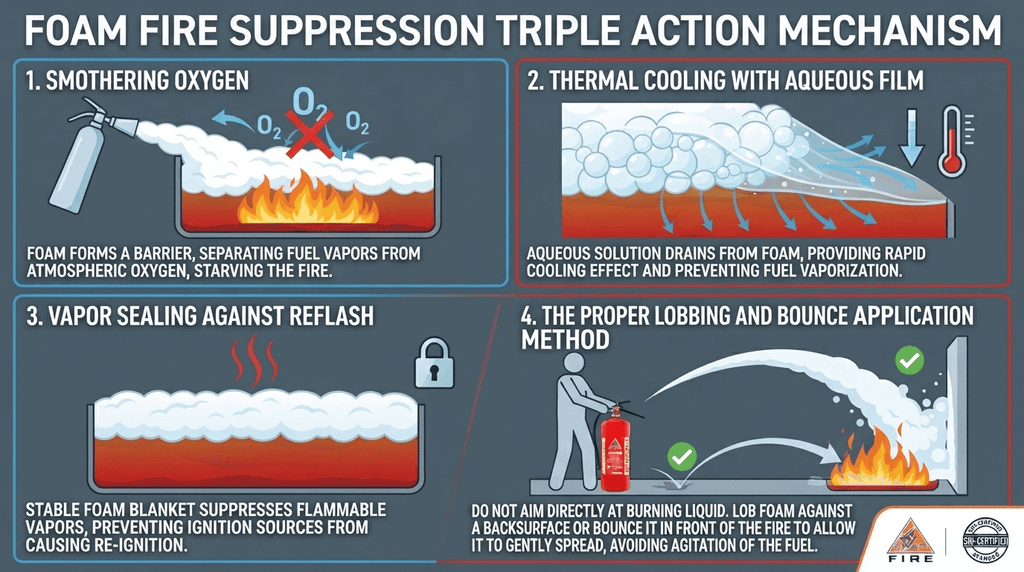
The “Triple Action” Mechanism
The foam blanket attacks the fundamental components of the “fire tetrahedron” simultaneously in three ways:
- Smothering (Oxygen Displacement): Normal combustion needs oxygen (roughly above 16% concentration). The stable foam layer blankets the surface of the burning liquid, creating an impervious barrier that prevents atmospheric oxygen from reaching the fuel source. The fire suffocates almost instantly.
- Cooling (Heat Reduction): Because the primary component of the foam solution is water, the discharge carries immense cooling properties. As the foam blanket spreads over the liquid and surrounding surfaces, it absorbs huge amounts of heat energy, dropping the fuel’s temperature below its ignition point. This cooling is vital to prevent the “reflash” phenomenon.
- Separating & Vapor Suppression (The Key Feature): As the foam solution interacts with the burning liquid, a micro-thin aqueous film spreads across the fuel surface. This film effectively traps volatile flammable vapors beneath the surface. Normal hydrocarbons burn because their vapors ignite above the liquid; by sealing these vapors away from the air and cooling the surface, ignition becomes physically impossible.
This persistent vapor suppression is what Dry Chemical Powder extinguishers cannot do.
Understanding Fire Classifications: Where Foam Excels
To ensure safety and E-E-A-T compliance in facility safety planning, it is vital to know that Foam extinguishers are explicitly specialized tools for two distinct fire classes:
- Class A Fires (Ordinary Solids): These involve carbon-based materials that leave glowing embers, such as wood, paper, textiles, and plastics. The high water content and smothering capability of the foam extinguish Class A fires effectively, penetrating deep to prevent reignition.
- Class B Fires (Flammable Liquids): This is the ultimate specialist zone for foam. Class B fires involve hydrocarbons, chemicals, and fuels, such as petrol, diesel, kerosene, paint thinners, aviation fuel, and alcohols (polar solvents require specialized Alcohol-Resistant foam).
Crucial Warning: Standard Foam extinguishers are water-based. Do NOT use them on Class C (Electrical) fires involving live electronics. Water is conductive, and its application creates a severe electrocution hazard for the user and risks catastrophic short circuits that can destroy the entire system.
Comparison: Why Choose Foam Over Powder for Liquids?
Facility managers and safety officers frequently ask why they should purchase specific Foam units rather than relying on cheaper ABC Dry Chemical Powder extinguishers. Here is the comparative expertise breakdown:
| Feature | Dry Chemical Powder (ABC) | Foam (AFFF / Class B Specialized) |
|---|---|---|
| Residue | Leaves corrosive, caking dust | Minimal liquid residue; evaporates, minimal cleanup. |
| Cooling | Almost None | Excellent cooling properties (water-based). |
| Vapor Suppression | None | Outstanding vapor seal; physically locks in flammable vapors. |
| Reignition Risk | High (in liquids). Powder can blow away, re-exposing hot fuel. | Extremely Low. The persistent film remains active even after discharge. |
| Secondary Damage | Damages electronics and machinery due to corrosion and dust inhalation. | Low. Minimal cleanup required; avoids corrosive damage. |
When handling chemical or fuel spills, Foam is the undisputed gold standard. Dry powder can extinguish a small flammable liquid puddle, but the intense heat remains. If a spark occurs after the powder has dispersed or failed to cover the entire puddle, the vapors will instantly reignite violently. Foam’s persistent vapor suppression prevents this reflash completely.
Ideal Applications: Where and When to Install Foam APARs
Because of their liquid-smothering powerhouse capabilities, Foam APARs are mandatory for specific hazardous environments where hydrocarbons and chemicals are present:
Industrial & Commercial Zones
- Refineries & Chemical Plants: Handling massive volumes of gasoline, diesel, and raw chemical compounds.
- Fuel Storage Depots & Loading Bays: Where transfer procedures are volatile.
- Paint Manufacturing & Storage Facilities: Utilizing highly flammable solvents.
- Aviation Hangars: Shielding aircraft fuel systems and specialized liquids.
- Car Garages & Workshops: Dealing with various oils, fuels, and chemical cleaners.
Residential & Small Business Zones
- Home Garages: If you store extra cans of gasoline for a generator, car cleaning solvents, or paint thinners.
- Workshops & Sheds: Where DIY projects utilize flammable liquids.
Proper Application Technique: The Lobbing or Bounce Method
Using a foam extinguisher requires specific technique. If you spray the pressurized foam directly into the center of a burning liquid pool, the force of the jet can splash the burning fuel out of the container and spread the fire rapidly.
Instead, safety professionals must utilize the Lobbing Method or the Bounce Method:
- Verify: Confirm the fire involves liquids (Class B) or solids (Class A), and is NOT electrical.
- Pull the Pin: Following the standard PASS acronym, pull the safety pin.
- Aim at a Barrier: If the flammable liquid is contained within a barrel, tank, or walled area, do not aim directly at the liquid. Instead, aim the nozzle at the back wall of the container, just above the burning liquid.
- Discharge & Spread: Squeeze the operating lever. By hitting the vertical surface, the foam solution dynamically breaks down and forms a thick blanket that gracefully spreads across the liquid surface, locking in the threat without turbulence.
- Let it Blanket: Once the fire appears extinguished, do not stop. Apply the remaining solution to ensure a comprehensive, vapor-tight blanket is maintained over the entire fuel surface. Do not break this surface after application.
Choosing Certified Quality: Why Sysco Fire is Your Authority in Fire Protection Engineering
Fire safety equipment is not simply a commodity; it is engineering designed to perform under catastrophic stress. When facing a volatile chemical spill, you cannot risk the reliability of your extinguisher.
At Sysco Fire, we bring years of experience and specialized fire engineering expertise to the manufacturing process. We ensure our Foam APAR solutions meet and exceed Indonesian SNI standards for reliability and performance. When you choose a Sysco Fire extinguisher, you are not just buying a cylinder; you are trusting an organization dedicated to maximum safety and authoritativeness in fire suppression.
Conclusion: Protect Your Assets against Flammable Threats
Chemical and fuel fires are fast-moving, intensely hot, and exceptionally volatile. Standard firefighting methods are not just ineffective—they are often dangerous. The Foam Fire Extinguisher stands as a specialized masterpiece of fire engineering, dynamically combining cooling, smothering, and persistent vapor suppression. By equipping your critical high-risk zones with certified Foam extinguishers and training your personnel in proper application techniques, you establish an impenetrable line of defense against catastrophic chemical or fuel disasters.
Baca juga : Metode APAR TATS K3: 4 Langkah Praktis Menggunakan APAR dengan Aman dan Tepat.
Equip Your Facility with Engineering-Grade Fire Safety Solutions
Do not compromise on safety when dealing with volatile chemicals and fuels. Secure your facility today with certified fire suppression equipment from Indonesia’s fire engineering expert.
- Explore Certified Fire Safety Engineering: For general information regarding fire safety standards, manufacturer expertise, and large-scale safety engineering solutions, visit Indonesia’s fire protection leader official website at https://sysco-fire.co.id.
- Browse Our APAR & specialized Catalog: Explore our complete range of certified foam, powder, CO2, and clean agent extinguishers at https://sysco-fire.co.id/apar-alat-pemadam-api-kebakaran.
- Connect Directly with Technical Experts: Need professional help calculating your hazard risk profile or selecting the proper fire extinguisher size for your facility? Connect with our safety specialists via WhatsApp at +62 852-5711-4711 or click here to redirect directly to our official customer service desk: https://sysco-fire.co.id/cs.