When it comes to fire safety, preparation is the line that separates a minor incident from a catastrophic disaster. Equipping your home, commercial building, or industrial facility with a Fire Extinguisher (commonly known in Indonesia as APAR or Alat Pemadam Api Ringan) is undeniably the most critical first step in protecting lives and valuable property. However, simply purchasing an extinguisher and mounting it on a wall is not where your responsibility ends.
Fire extinguishers are highly pressurized mechanical vessels filled with specialized chemical agents. Like any piece of mechanical equipment, they are susceptible to wear, tear, environmental degradation, and pressure loss over time. An unmaintained fire extinguisher provides a false sense of security; it may fail to discharge, leak its propellent, or deploy weakly precisely when you need it most. To align with Experience, Expertise, Authoritativeness, and Trustworthiness principles in fire safety management, this comprehensive guide will detail the 7 crucial ways to maintain your APAR, ensuring it remains in peak operational condition for any emergency.
Table of Contents
1. Conduct Rigorous and Regular Visual Inspections
The foundation of fire extinguisher maintenance begins with a thorough visual inspection, which should ideally be conducted at least once a month. The physical environment can be harsh on pressurized cylinders. If your extinguisher is located outdoors, in a humid kitchen, or in a corrosive industrial setting, it is particularly vulnerable to degradation.
During your monthly visual check, inspect the cylinder body meticulously for any signs of physical damage. Look for dents, severe scratches, or gouges in the metal, which could weaken the structural integrity of the pressurized tank. Rust and corrosion are major red flags, especially around the base of the cylinder and the welding seams. If a cylinder is heavily rusted, it could potentially burst during operation, causing severe injury to the user. Additionally, inspect the rubber hose and nozzle. Ensure the hose is not cracked, dry-rotted, or blocked by debris, insects, or accumulated dirt. A blocked nozzle can cause the extinguisher to malfunction or the pressure to backfire.
2. Monitor the Pressure Gauge Consistently
The pressure gauge is the health monitor of your fire extinguisher. For the extinguisher to propel its extinguishing agent (whether it be dry chemical powder, foam, or water) forcefully enough to smother a fire, it must maintain a very specific internal pressure.
On standard extinguishers, you will find a circular dial gauge. The needle of this gauge must always point squarely in the green zone.
- Undercharged (Left of Green): If the needle has dropped below the green area, the extinguisher has lost pressure. This could be due to a microscopic leak in the cylinder, a faulty valve, or a previous partial discharge. An undercharged extinguisher will not have enough force to spray the agent onto the fire, rendering it virtually useless.
- Overcharged (Right of Green): While less common, an overcharged extinguisher is equally dangerous. This can happen due to extreme temperature fluctuations (like being left in a hot vehicle or near a furnace) which cause the internal gases to expand. An overcharged unit carries a risk of leaking or even catastrophic cylinder failure.
Note: Carbon Dioxide (CO2) extinguishers do not have pressure gauges. Their readiness is determined by weighing the cylinder to ensure no gas has escaped.
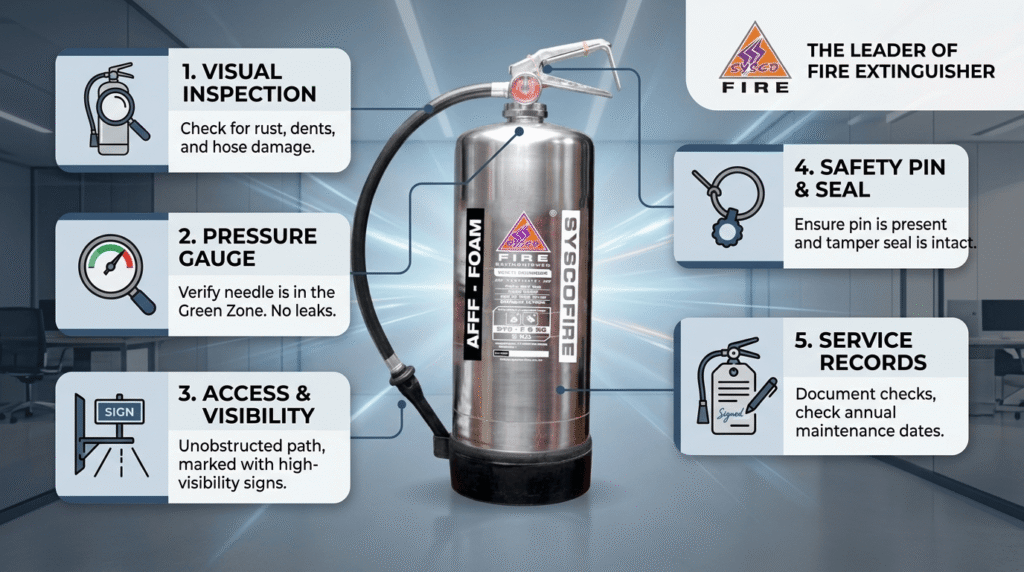
3. Ensure Unobstructed Access and Clear Visibility
In the event of a fire, every single second counts. A fire can double in size every 60 seconds. Therefore, the physical placement and accessibility of your APAR are just as critical as its mechanical condition. A perfectly functioning extinguisher is useless if you cannot reach it in time.
Ensure that the extinguisher is not blocked by boxes, furniture, machinery, or office equipment. The path to the extinguisher must remain entirely unobstructed at all times. Furthermore, the extinguisher should be highly visible. Use clear, photoluminescent (glow-in-the-dark) signage pointing directly to the extinguisher’s location, ensuring it can be found even if the power goes out and the room fills with smoke. The mounting height is also governed by safety standards; heavy extinguishers should be mounted lower, but never directly resting on the floor where they can be kicked, dented, or exposed to pooling water and floor cleaning chemicals.
4. Verify the Safety Pin and Tamper Seal Integrity
Every portable fire extinguisher is equipped with a metal or plastic safety pull-pin inserted into the handle, secured by a plastic tamper seal (similar to a zip-tie). This mechanism exists for two primary reasons: to prevent accidental discharge if the extinguisher is bumped or dropped, and to provide visual evidence of whether the unit has been used or tampered with.
During your monthly maintenance check, verify that the metal pin is firmly in place. More importantly, check the plastic tamper seal. If the seal is broken or missing altogether, it is a massive warning sign. A missing seal often indicates that someone may have pulled the pin and slightly squeezed the handle. Even a momentary discharge of a fraction of a second is enough to introduce powder into the valve seal, which will cause the remaining pressure gas to slowly leak out over the following days or weeks. If you find a broken seal, the extinguisher must be immediately inspected and likely recharged by a professional.
5. Prevent Compaction: The “Shake and Invert” Method
This step is specifically critical for Dry Chemical Powder extinguishers (APAR Kelas ABC), which are the most common type used in homes and offices. The extinguishing agent inside is a very fine, dust-like chemical powder. Over time, due to gravity, building vibrations, or proximity to heavy machinery, this fine powder can settle at the bottom of the cylinder and become tightly compacted, a process known as “caking.”
If the powder becomes a solid block at the bottom of the tank, the pressurized gas will simply blow past it when activated, discharging only gas and no fire-retardant powder. To prevent caking, you should perform a physical “shake and invert” routine every month. Take the extinguisher off its mount, turn it completely upside down, and gently strike the bottom of the cylinder with the heel of your hand or a rubber mallet. You should be able to feel or hear the heavy powder shifting and sliding freely inside the tank. If it feels like a solid brick, the extinguisher needs professional servicing.
6. Maintain Meticulous Inspection Records (The Service Tag)
Safety compliance is not just about doing the work; it is about documenting it. Every commercial fire extinguisher should have a paper or durable plastic inspection tag attached to it. This tag is the official medical history of your safety equipment.
Every time you or your safety officer performs the monthly visual and physical checks mentioned above, the back of the tag must be dated and initialed. This meticulous record-keeping serves multiple purposes. First, it creates a culture of accountability, ensuring the monthly checks are not skipped or forgotten. Second, in the event of an incident, insurance companies and local fire marshals (Damkar) will look at these tags to verify that the facility owners were not negligent in their fire safety duties. Keep the tags legible and replace them if they become torn or water-damaged.
7. Schedule Professional Annual Maintenance and Hydrostatic Testing
While monthly visual inspections by staff or homeowners are essential, they do not replace the need for professional, in-depth maintenance. According to international fire safety standards and local Damkar regulations, all fire extinguishers must undergo a thorough inspection by a certified fire safety technician at least once a year.
During an annual inspection, a professional will check internal valve components, assess the exact weight of the agent, verify thread integrity, and ensure the propellant is pristine. Furthermore, extinguishers require periodic Hydrostatic Testing (typically every 5 to 12 years, depending on the cylinder type). This is a highly specialized process where the cylinder is emptied, filled with water, and subjected to pressures far exceeding its normal operating capacity to test the metal for micro-fractures, metal fatigue, and structural weaknesses. If a cylinder fails a hydrostatic test, it is permanently condemned and destroyed, as it poses an explosion risk. Never attempt to perform internal maintenance or recharging on your own; always rely on certified professionals.
Conclusion
A fire extinguisher is an indispensable tool for halting a small localized fire before it escalates into an uncontrollable inferno. However, the reliability of that tool is entirely dependent on how well it is maintained. By dedicating just a few minutes each month to visually inspecting the cylinder, checking the pressure gauge, verifying the tamper seals, preventing powder compaction, and ensuring unobstructed access, you drastically increase your emergency readiness. Coupled with annual professional servicing, these 7 maintenance steps guarantee that your APAR will function optimally, protecting your property and the lives of those within it. Do not wait for a fire to discover your extinguisher is empty or broken.
Baca juga: Jarak Ideal APAR K3: 11 Panduan Menentukan Posisi APAR yang Tepat.
Ensure Your Safety with Certified Fire Protection Solutions
Is your fire extinguisher due for a refill, or do you need to equip your facility with new, reliable safety equipment? Don’t compromise on quality when lives are on the line.
- Discover Premium Fire Safety Products: Visit our official website for comprehensive safety solutions at https://sysco-fire.co.id.
- Explore Our Extinguisher Catalog: Find the exact APAR suited for your specific needs by checking our detailed product page at https://sysco-fire.co.id/apar-alat-pemadam-api-kebakaran.
- Need Immediate Professional Assistance? For free consultations, refill services, and purchasing inquiries, chat with our experts directly on WhatsApp at +62 852-5711-4711 or click here to connect: https://sysco-fire.co.id/cs.