
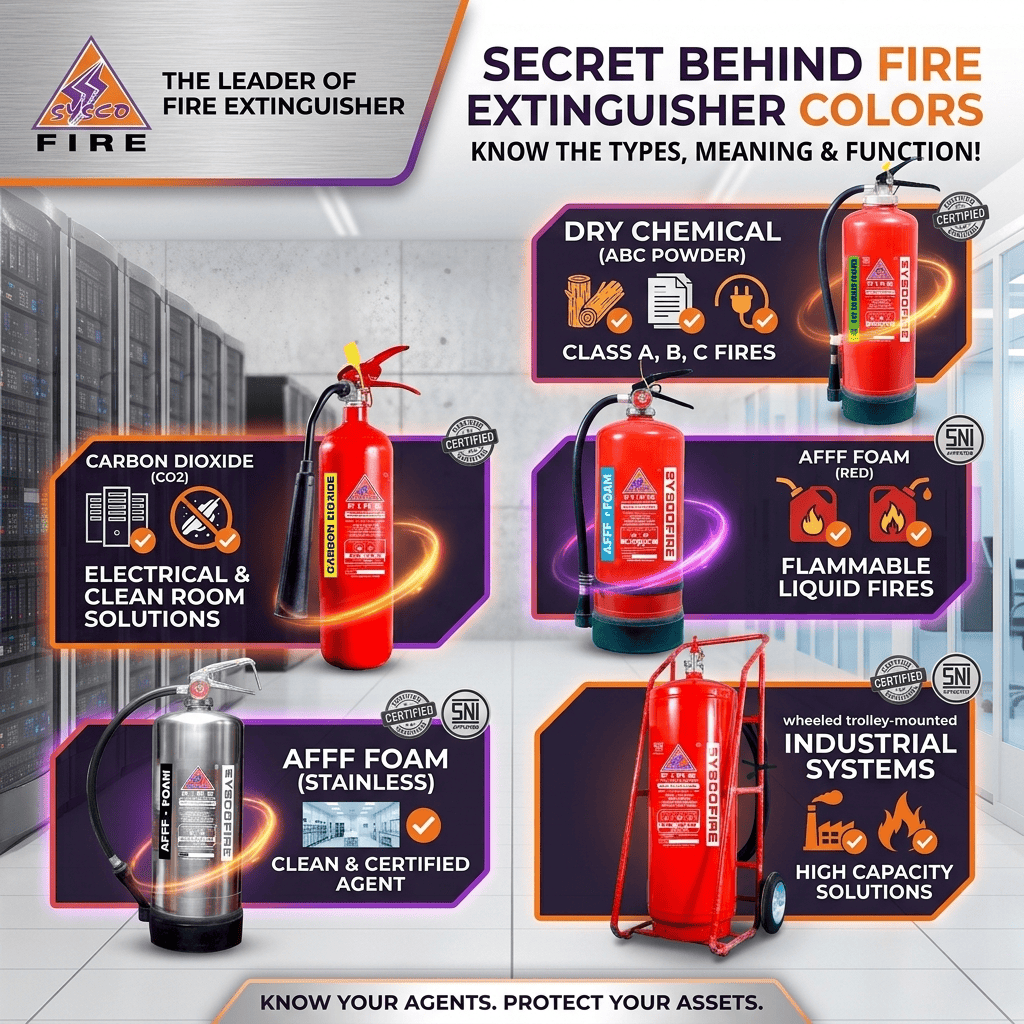
Walk into any modern office building, industrial warehouse, or commercial kitchen, and you will undoubtedly spot a fire extinguisher mounted on the wall. At a quick glance, they all seem to look the same—heavy, cylindrical, and painted in a striking, bright red. However, if you look closer, you will notice distinct blocks of color on their labels or specifically colored bands wrapping around the cylinder’s neck.
These colors are not aesthetic design choices made by the manufacturer. They are a universal, life-saving visual language.
In a high-stress fire emergency, panic sets in instantly. The human brain struggles to read fine print or comprehend complex instructions when adrenaline is pumping. Fire safety engineers and international regulatory bodies recognized this, developing a standardized color-coding system that allows anyone to identify the contents of an extinguisher—and its appropriate use—in a fraction of a second.
Understanding the secret behind the colors of a fire extinguisher (commonly known as APAR or Alat Pemadam Api Ringan in Indonesia) is one of the most critical safety skills you can possess. Using the wrong color on the wrong type of fire is not just ineffective; it can be a fatal mistake that accelerates the blaze. In this comprehensive guide, we will decode exactly what each color means, how the chemicals function, and when to use them safely.
Table of Contents
Why is the Main Cylinder Always Red?
Before diving into the specific color codes, it is important to understand why the primary body of almost all fire extinguishers is painted Signal Red.
Globally, red is the universally recognized color for danger, stop, and fire emergencies. From a practical engineering standpoint, red offers the highest visual contrast against most background environments (white walls, grey industrial concrete, etc.). In low-visibility situations, such as a smoke-filled corridor or during a power outage, a bright red cylinder is much easier for the human eye to locate.
However, because one single extinguishing agent cannot safely put out every type of fire, international standards (such as the BS EN 3 standard, widely adapted in Indonesia and globally) require a secondary color code. This is usually presented as a large, brightly colored band across the label.
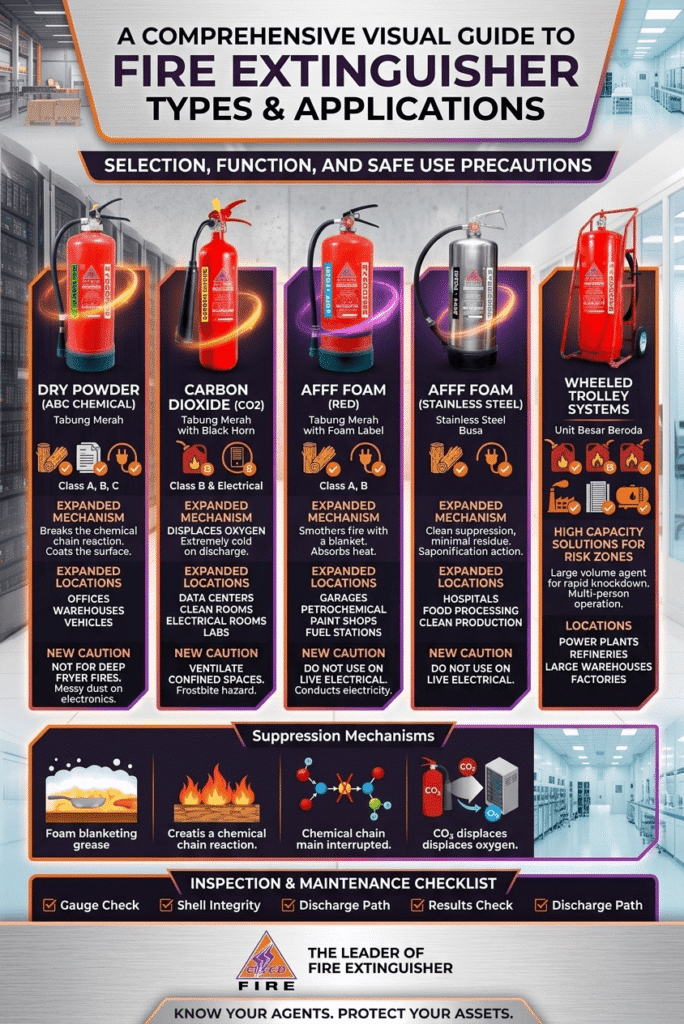
Here is the definitive guide to the 5 primary fire extinguisher color codes.
1. Signal Red: Water Fire Extinguishers
When the entire label or the specific color band is solid Signal Red, the extinguisher contains plain water, sometimes mixed with an anti-freeze additive.
- How it Works: Water extinguishes fire through a rapid cooling mechanism. By soaking the burning material, it absorbs the heat, dropping the temperature of the fuel below its ignition point.
- Safe to Use On: Class A fires only. This includes ordinary combustible solid materials such as wood, paper, cardboard, textiles, and plastics.
- The Danger of Misuse: You must never use a red water extinguisher on an electrical fire (Class C) or a flammable liquid fire (Class B). Water conducts electricity, meaning the operator could suffer a lethal electric shock. If sprayed on a cooking oil or gasoline fire, the water will instantly vaporize, causing the burning oil to explode outward and spread the fire rapidly.
2. Pale Cream: Foam Fire Extinguishers
A Pale Cream colored band indicates that the cylinder contains Aqueous Film-Forming Foam (AFFF).
- How it Works: Foam extinguishers work by smothering the fire. When sprayed, the foam expands and creates a thick, cooling blanket over the surface of the burning fuel. This blanket cuts off the fire’s oxygen supply and traps flammable vapors, preventing them from igniting.
- Safe to Use On: Class A (solids like wood and paper) and Class B (flammable liquids like gasoline, diesel, paint, and solvents).
- The Danger of Misuse: While highly effective on liquid fires, standard foam extinguishers are largely water-based. Therefore, just like a water extinguisher, they should strictly be avoided when dealing with live electrical fires (Class C) or deep-fat fryer fires (Class K/F).
3. French Blue: Dry Powder (Dry Chemical)
If you see a French Blue band, you are looking at a Dry Chemical Powder extinguisher (often containing Monoammonium Phosphate). This is the most common type of fire extinguisher found in general office spaces, vehicles, and homes due to its versatility.
- How it Works: Dry powder does not cool the fire. Instead, it acts as a chemical barrier. When the fine powder hits the flames, it melts and interferes with the chemical chain reaction of the combustion process, instantly knocking down the flames.
- Safe to Use On: It is often called the “ABC” extinguisher because it is effective on Class A (solids), Class B (flammable liquids), and Class C (electrical fires). The powder is non-conductive, making it safe to use around live electronics.
- The Danger of Misuse: While incredibly versatile, dry powder has drawbacks. Discharging it in a small, poorly ventilated room will create a massive cloud of dust, blinding the operator and making breathing difficult. Furthermore, the powder leaves a corrosive residue that can permanently damage sensitive electronic equipment like servers or circuit boards.
4. Black: Carbon Dioxide (CO2)
A Black colored band signifies a Carbon Dioxide (CO2) fire extinguisher. These are easily recognizable not just by their color, but also by their distinctive hard, horn-shaped nozzle.
- How it Works: CO2 is a non-flammable gas. The extinguisher releases this gas under immense pressure. Because CO2 is heavier than oxygen, it rapidly displaces the oxygen surrounding the fire, effectively suffocating it. Secondly, the gas is expelled at sub-zero temperatures, providing a freezing effect.
- Safe to Use On: Class B (flammable liquids) and Class C (electrical equipment). Because it leaves absolutely zero residue, CO2 is the mandatory choice for computer server rooms, laboratories, and areas with highly sensitive, expensive electronic equipment.
- The Danger of Misuse: You must handle CO2 extinguishers with extreme caution. The gas exits the nozzle so cold that it can cause instant frostbite to the skin (never hold the horn itself; hold the insulated grip). Additionally, using a CO2 extinguisher in a confined, unventilated space can cause asphyxiation (lack of oxygen) for the operator. It is also ineffective on Class A fires, as the high-pressure gas can simply blow burning paper or embers around the room.
5. Canary Yellow: Wet Chemical
A Canary Yellow band identifies a Wet Chemical fire extinguisher. These are highly specialized units designed primarily for commercial kitchens and the food service industry.
- How it Works: Wet chemical extinguishers use a liquid solution of potassium salts. When sprayed onto incredibly hot burning oils, the chemical reacts with the fat in a process called saponification. This reaction turns the burning oil into a thick, soapy, non-combustible foam crust. This crust seals in the combustible vapors, cuts off the oxygen, and rapidly cools the extreme heat of the cooking oil.
- Safe to Use On: Class K (or Class F in Europe/Australasia) fires, which involve high-temperature cooking oils and animal fats used in deep fryers. They can also be used on Class A fires if necessary.
- The Danger of Misuse: These should not be used on electrical equipment or standard flammable liquid fires (gasoline/fuels) where they are highly ineffective. Using any other type of extinguisher (like Water or CO2) on a deep-fryer fire will cause a violent explosion of boiling oil; only Wet Chemical (Yellow) is guaranteed safe for this specific hazard.
Conclusion
A fire extinguisher is an indispensable tool for preserving life and property, but its effectiveness relies entirely on the knowledge of the person holding it. The color-coded bands—Red for Water, Cream for Foam, Blue for Dry Powder, Black for Carbon Dioxide, and Yellow for Wet Chemical—are designed to remove the guesswork from an emergency situation.
By familiarizing yourself and your employees with this visual language, you ensure that the right tool is used for the right hazard, preventing a controllable emergency from escalating into a total disaster. Always check the color, verify the classification symbols, and ensure your equipment is properly certified and maintained.
Baca juga: Berkualitas? 11 Checklist Wajib Sebelum Menentukan Pilihan
Secure Your Environment with the Correct APAR Solutions from Sysco-Fire
Do you have the correct colored fire extinguishers installed for the specific fire hazards in your commercial or residential property? Don’t leave your safety to chance. Rely on the industry experts to equip you with premium, officially certified fire protection.
- Visit Our Official Website: Discover our comprehensive range of safety services and expert fire protection engineering at https://sysco-fire.co.id.
- Browse Our Product Catalog: Ensure you have the right agent for the right fire. View our full selection of certified Blue (Powder), Black (CO2), and Cream (Foam) extinguishers here: https://sysco-fire.co.id/Promo.
- Get Instant Expert Guidance: Need a facility assessment or help choosing the right APAR colors for your business? Contact our certified consultants directly via WhatsApp at +62852-5711-4711 for a fast, professional response!