
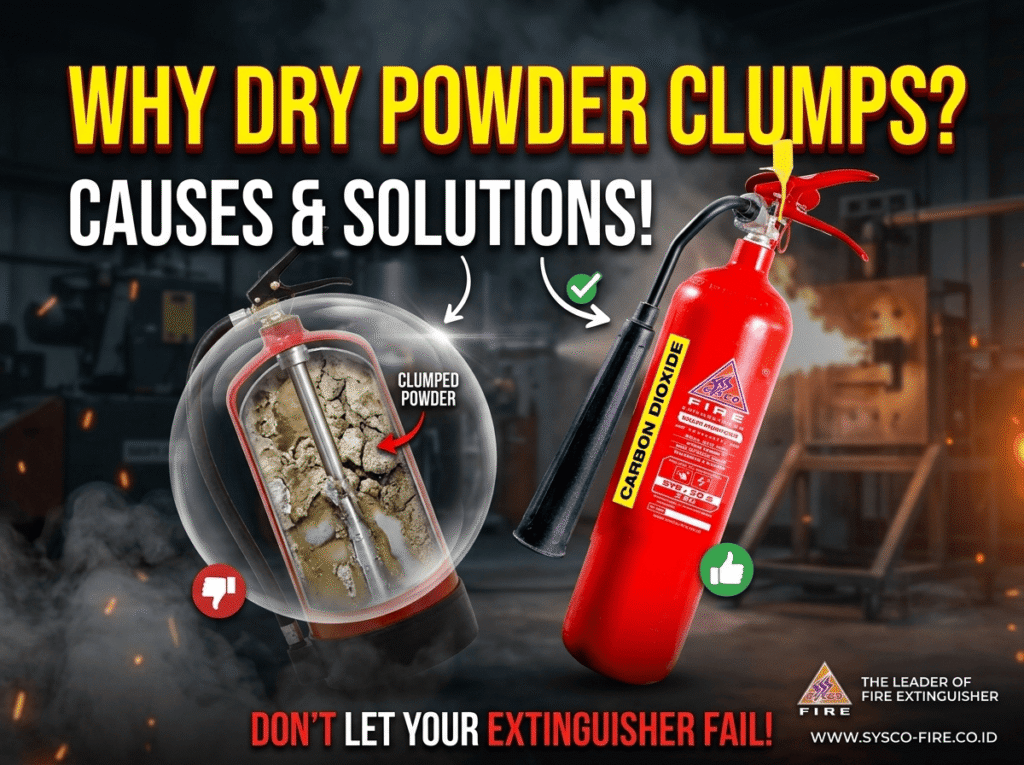
Dry Chemical Powder fire extinguishers (frequently referred to as ABC Dry Chemical APAR) are among the most versatile and widely deployed fire suppression tools in the world. Engineered to combat Class A (ordinary combustibles), Class B (flammable liquids), and Class C (electrical hazards) fires, these units are ubiquitous in industrial plants, commercial buildings, residential complexes, and motor vehicles.
However, dry chemical extinguishers possess a vulnerable physical trait: powder compaction and caking (clumping).
During an emergency, an operator siphons a lever, expecting a powerful, cloud-like stream of fire-retardant agent. Yet, if the internal chemical media has solidified into a dense, cement-like block, the pressure will either discharge empty propellant gas or jam the discharge valve entirely.
Understanding why dry chemical powder clumps, how to detect it early, and what preventive steps guarantee fluid powder movement is critical for facility managers, safety officers, and building owners.
Table of Contents
What Is Dry Chemical Powder Made Of?
To understand why powder clumps, we must first look at its chemical composition and physical properties.
Modern ABC dry chemical extinguishers rely primarily on Monoammonium Phosphate ( ), mixed with ammonium sulfate to enhance fire suppression capability. BC-type extinguishers often utilize Sodium Bicarbonate (
 ) or Potassium Bicarbonate (
 ).
).
In their manufactured state, these chemicals are ground into ultra-fine, microscopic particles (typically between  ). To prevent natural agglomeration, reputable manufacturers treat the raw powder with hydrophobic additives—most commonly silicone fluid (polydimethylsiloxane) or metallic stearates.
This micro-thin silicone coating forms a fluidizing barrier around each particle, repelling ambient moisture and allowing the powder to flow smoothly like a liquid when pressurized nitrogen gas is released.
When this protective barrier breaks down or environmental conditions overwhelm the chemical formulation, the individual particles fuse together—a phenomenon known as caking.
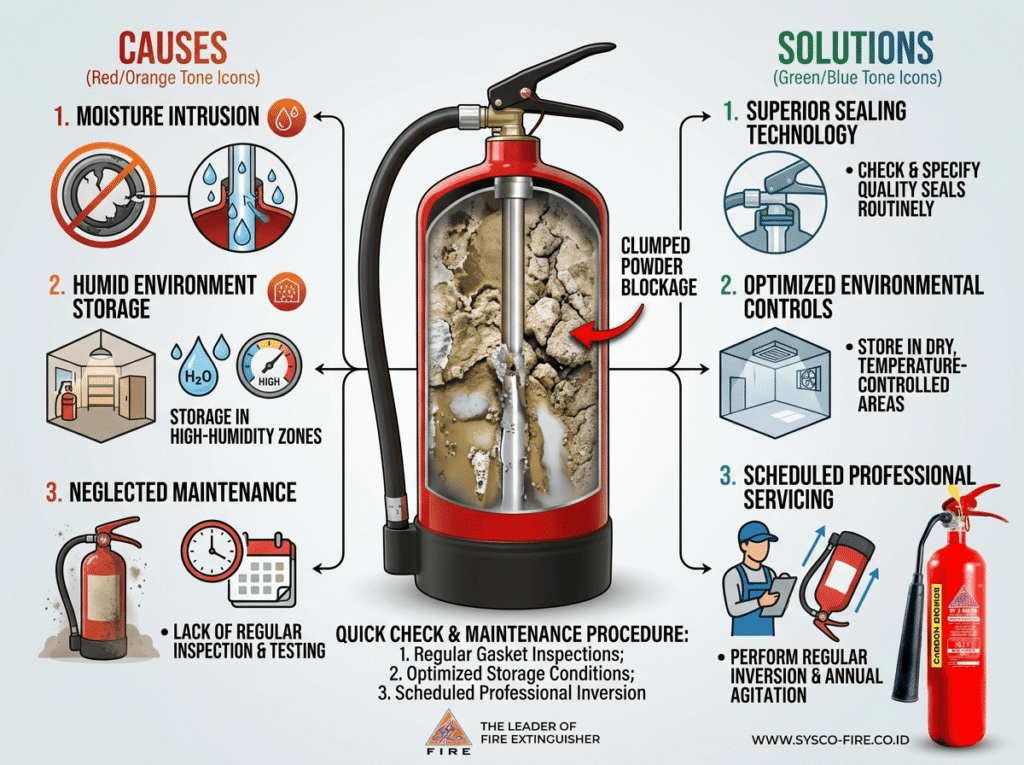
The 5 Primary Causes of Dry Powder Clumping
Clumping does not happen by accident; it is the direct result of environmental exposure, mechanical stress, or substandard manufacturing. Here are the five primary drivers of powder compaction:
1. Humidity and Moisture Ingress (Hygroscopic Attraction)
Monoammonium phosphate and sodium bicarbonate are naturally hygroscopic—meaning they readily attract and absorb water vapor from the surrounding atmosphere.
- Imperfection in Valve Seals: Over months or years, microscopic degradation in rubber O-rings, valve stems, or gauge threads allows trace amounts of ambient moisture to seep into the sealed cylinder.
- Refilling in Uncontrolled Environments: If an extinguisher is recharged in a room with high humidity without dry nitrogen purging, moist air becomes trapped inside the cylinder alongside the powder.
Once moisture enters, the micro-coating on the powder particles dissolves or breaks down. The damp chemical particles bind together into sticky agglomerates. As internal temperatures fluctuate, this wet mass dries into hard, solid crusts inside the base of the cylinder.
2. Mechanical Vibration and Gravitational Compaction
Extinguishers installed on heavy machinery, transport trucks, marine vessels, or near industrial factory equipment are subjected to continuous vibration.
Under constant rhythmic shaking, gravity forces fine particles into the void spaces between larger particles. Over extended periods, this mechanical settling drives out trapped nitrogen gas, compressing the loose powder into a dense, packed cake at the bottom of the cylinder. This process is known as vibrational compaction.
3. Thermal Cycling and Heat Fluctuation
Exposing fire extinguishers to dramatic temperature swings causes internal condensation and physical alteration of the chemical agent:
 When extinguishers are mounted outdoors under direct sun exposure or near heat-generating machinery, ambient temperatures inside the cylinder can climb above 50 Celcius (122 Celcius ). When night falls, temperatures drop rapidly, creating micro-condensation on the interior steel walls. Repeating this cycle hundreds of times bakes the powder into rigid lumps.
4. Cross-Contamination of Incompatible Chemicals
During routine maintenance or refilling by uncertified service providers, different types of chemical agents are sometimes accidentally mixed or filled using contaminated hoppers.
- Mixing ABC (Monoammonium Phosphate) and BC (Sodium Bicarbonate): Combining these two chemical agents creates a severe chemical reaction. The acidic monoammonium phosphate reacts with the alkaline sodium bicarbonate, releasing water vapor and carbon dioxide gas (CO2) inside the closed cylinder:
This reaction rapidly converts loose powder into a solid, sticky block while generating dangerous internal pressure spikes.
5. Substandard or Uncertified Powder Media
Not all fire extinguisher powders are manufactured to equal standards. Low-cost, uncertified chemical media often feature:
- Insufficient or uneven silicone coating.
- Impure raw materials with high natural moisture content.
- Irregular, coarse grain sizes that lock together easily under pressure.
The Dangerous Consequences of Clumped Powder
When a dry chemical agent clumps inside a fire extinguisher, the consequences during an emergency are catastrophic:
| Issue | Physical Mechanism | Result in Emergency |
| Siphon Tube Blockage | Solidified chunks block the pick-up tube inlet at the bottom of the tank. | Gas escapes through the valve, but zero extinguishing agent is discharged. |
| Nozzle & Hose Clogging | Small lumps travel up the tube and jam inside the narrow nozzle orifice. | Immediate loss of pressure; discharge hose bursts or stops working entirely. |
| Reduced Effective Range | Partially clumped powder reduces propellant efficiency. | Agent travels only a few inches instead of the standard  , exposing the user to direct flames. , exposing the user to direct flames. |
How to Check If Your Powder Extinguisher Is Clumped
Facility managers can perform a simple non-destructive diagnostic check during monthly visual inspections:
STEP 1: INVERT EXTINGUISHER
|
v
[ TURN upside down ]
|
+—————+—————+
| |
v v
(FEEL / HEAR SLIDING) (NO MOVEMENT / SOLID)
| |
v v
[ POWDER IS FLUID ] [ POWDER IS CLUMPED ]
(Passes Basic Test) (Requires Service/Refill)
- The Inversion Test (The “Sliding Sound”): Unmount the extinguisher, hold it securely, and invert it upside down. Listen and feel carefully for the movement of the chemical agent.
- Healthy Powder: You will feel a smooth, fluid “sliding” motion (similar to sand in an hourglass) as the powder shifts from the bottom to the top of the cylinder.
- Clumped Powder: If you feel a heavy, dull “thud” or feel no movement at all, the powder has compacted into a solid mass.
- The Rubber Mallet Technique (For Minor Compaction): If mild settling has occurred, gently tap the bottom collar of the cylinder with a soft rubber mallet while holding the unit upside down. This breaks light gravitational settling without damaging the cylinder wall or valve assembly.
Important: Never use a steel hammer or metal tool to strike a pressurized fire extinguisher, as this can crack the internal lining, damage the pressure vessel, or cause accidental discharge.
Solutions & Best Practices to Prevent Powder Clumping
Preventing dry chemical powder from caking requires a combination of proper equipment selection, ideal placement, and rigorous maintenance protocol.
1. Procure High-Grade, Hydrophobic Certified APAR
Always purchase fire extinguishers filled with premium, highly silicone-treated dry chemical powder certified by recognized standards (such as ISO, CE, or national standards like SNI/Permenaker). Premium silicone encapsulation resists moisture absorption even under demanding environmental conditions.
2. Implement Routine Inversion during Monthly Inspections
Incorporate the inversion technique into your regular monthly maintenance schedule. Inverting the cylinder for 10–15 seconds once a month aerates the chemical agent, breaks up early particle compaction, and ensures fluid readiness.
3. Install Anti-Vibration Mounts for Vehicles and Vessels
If installing extinguishers on trucks, heavy equipment, or marine vessels, use specialized heavy-duty brackets equipped with rubber vibration dampeners. Position vehicle units vertically rather than horizontally whenever possible to minimize uneven vibrational settling.
4. Shield Extinguishers from Harsh Environmental Elements
Protect outdoor extinguishers by housing them inside protective APAR wall boxes or UV-resistant fabric covers. Avoid placing units directly adjacent to boilers, steam lines, or direct rainfall.
5. Enforce Professional Refilling and Hydrostatic Testing
Ensure that servicing, refilling, and internal inspections are conducted exclusively by certified fire protection technicians. Professional service centers utilize dry nitrogen purging and sealed hopper systems to prevent room humidity from contaminating the chemical powder during maintenance.
Conclusion & Summary
Dry powder fire extinguishers are highly effective life-safety tools, but their reliability depends entirely on maintaining fluid chemical agent movement inside the cylinder.
- Moisture, heat, vibration, and low-quality chemicals are the main triggers that cause powder to clump or cake.
- Regular monthly inversion checks, proper environmental placement, and choosing certified equipment prevent compaction issues before emergency strikes.
Do not wait for a fire emergency to discover whether your safety equipment works. Inspect your dry chemical units today.
Baca juga : Komponen APAR: 11 Bagian yang Sering Diabaikan, tapi Penting Saat Darurat.
Partner with Certified Fire Safety Professionals
Ensure your residential, commercial, and industrial properties are fully protected with high-performance, certified fire extinguishers engineered for maximum reliability.
For expert technical guidance, industrial equipment procurement, and official product specifications, visit our primary website official https://sysco-fire.co.id.
Explore our full catalog of certified ABC Dry Chemical Powder, AFFF Foam, and CO2 units on our dedicated https://sysco-fire.co.id/Promo.
Need immediate assistance with refilling, technical inspections, or bulk order quotations? Connect directly with our certified technical engineers on WhatsApp at +62852-5711-4711 via our official https://sysco-fire.co.id/cs.