When outfitting a home, office, or industrial facility with fire safety equipment, one of the most common mistakes property owners make is assuming that all fire extinguishers are created equal. Walking into a hardware store or browsing an online catalog and simply picking the first extinguisher you see can be a fatal error. Fire Extinguishers—commonly known in Indonesia as APAR (Alat Pemadam Api Ringan)—come in a wide variety of sizes, typically ranging from a compact 1 kg up to a robust 9 kg for portable units, and even larger for wheeled units (APAB).
Selecting the correct size is not merely a matter of budget or wall space; it is a critical life-safety calculation. If you choose an extinguisher that is too small for your room, you risk running out of the extinguishing agent before the fire is fully suppressed, allowing it to reignite and spread. Conversely, if you choose an extinguisher that is too large, it may be too heavy for the occupants of the building to lift and operate effectively during a high-stress emergency.
To ensure your premises meet the highest standards of Experience, Expertise, Authoritativeness, and Trustworthiness (E-E-A-T) in fire safety, this comprehensive guide will walk you through the precise variables you must evaluate to choose the perfect APAR size for your specific room area and hazard level.
Table of Contents
Understanding the Relationship Between Cylinder Size and Fire Rating
Before calculating room dimensions, it is essential to understand what the “size” of a fire extinguisher actually means. When you see an APAR labeled as “3 kg” or “6 kg,” this number refers solely to the weight of the extinguishing agent inside the cylinder (such as Dry Chemical Powder or Carbon Dioxide), not the gross weight of the entire unit. A fully charged 6 kg Dry Chemical extinguisher, complete with its steel cylinder, valve assembly, and hose, will actually weigh closer to 9 or 10 kg.
Furthermore, the size of the extinguisher directly correlates to its discharge time and effective range.
- A 1 kg extinguisher might discharge completely in just 8 to 10 seconds.
- A 3 kg extinguisher typically provides about 12 to 15 seconds of continuous discharge.
- A 6 kg extinguisher will offer roughly 15 to 20 seconds of firefighting power.
- A 9 kg extinguisher provides around 20 to 25 seconds of discharge.
In a fire emergency, 15 seconds is a very short window. Therefore, the size of the cylinder dictates the volume of fire you can successfully combat before the unit is empty.
Step 1: Assess the Fire Hazard Level of Your Space
According to international fire safety standards (such as NFPA 10) and local Damkar (Fire Department) guidelines, room size is only half of the equation. You must first classify the “Hazard Level” of the room where the APAR will be placed.
1. Light (Low) Hazard
These are locations where the total amount of Class A combustible materials (paper, wood, cloth) and Class B flammables (small amounts of cleaning solvents) is relatively minor. Fires in these areas would spread slowly and have low heat release.
- Examples: Living rooms, standard office spaces, classrooms, boutique retail shops, and hotel guest rooms.
2. Ordinary (Moderate) Hazard
These locations contain a higher concentration of combustible materials. The fires here have the potential to grow faster and burn hotter than in light hazard areas.
- Examples: Parking garages, restaurant dining areas, medium-sized retail storage, hardware stores, and light manufacturing facilities.
3. Extra (High) Hazard
These are spaces packed with highly combustible materials, hazardous chemicals, or flammable liquids that would cause a fire to spread rapidly with intense heat.
- Examples: Carpentry and woodworking shops, auto repair garages, paint spraying facilities, heavy manufacturing plants, and large-scale warehouses.
Step 2: Sizing the APAR Based on Room Area and Hazard Level
Once you have determined the hazard level, you can begin matching the APAR size to your room’s square footage (area in square meters). Here are the authoritative guidelines for choosing the right capacity:
Small Spaces (Under 20 Square Meters)
For compact areas, maneuverability and quick access are key.
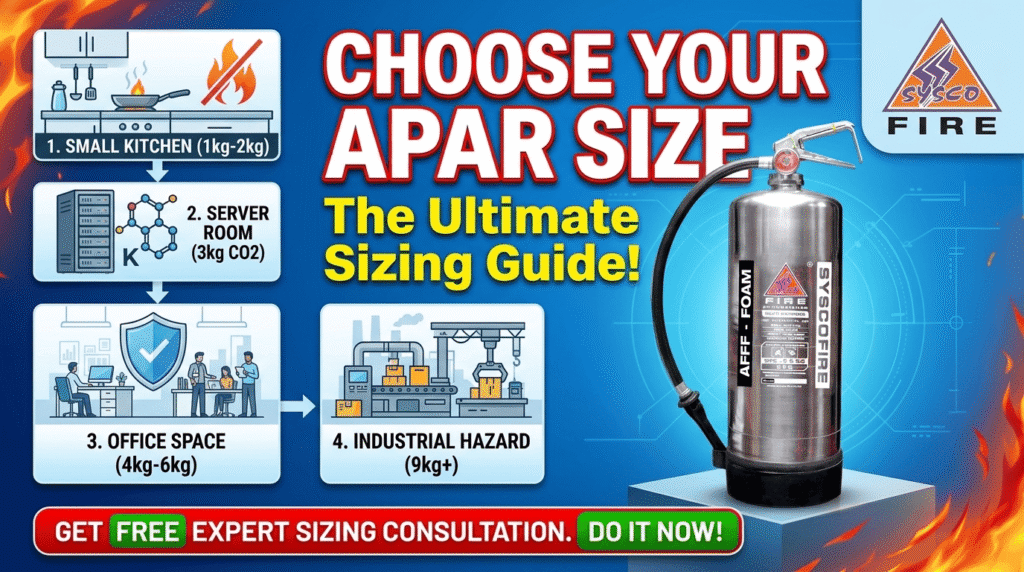
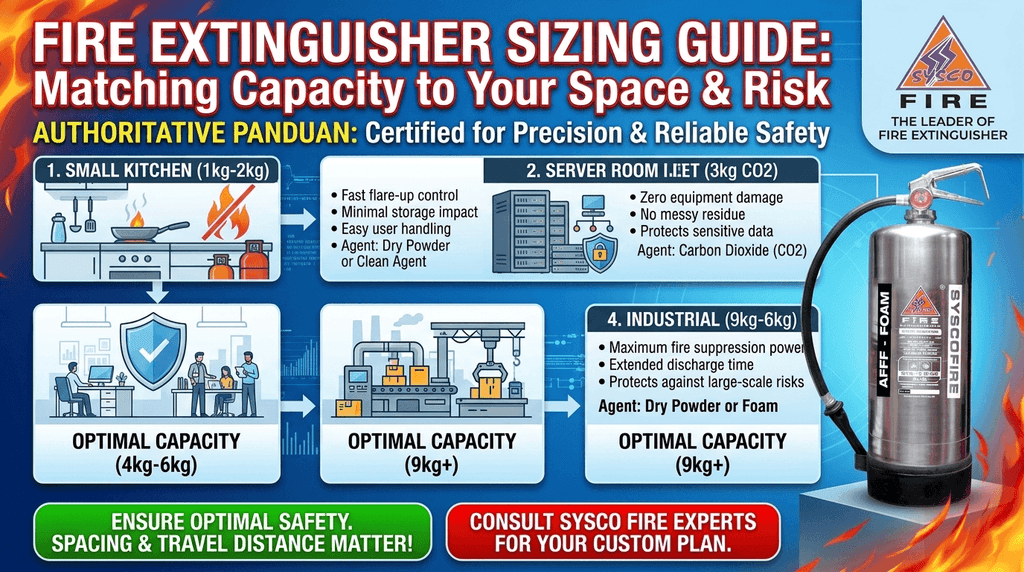
- Vehicles & Small Kitchens: A 1 kg to 2 kg Dry Chemical or clean agent extinguisher is ideal. It is lightweight, fits in tight compartments, and is sufficient to handle a small engine fire or a minor stovetop flare-up.
- Small Offices, Bedrooms, & Kiosks: A 3 kg extinguisher is the standard recommendation. It is lightweight enough for almost anyone to handle while providing enough agent to tackle a fire in a confined space before it reaches the ceiling.
Medium Spaces (20 to 50 Square Meters)
This category covers the majority of standard commercial and residential rooms.
- Living Rooms, Standard Retail, & Corridors: A 3 kg to 4 kg extinguisher provides the perfect balance. It offers sufficient discharge time for a growing fire without being overly cumbersome.
- Commercial Kitchens & Server Rooms: While the area might be medium, the hazard is specific. For server rooms, a 3 kg to 5 kg Carbon Dioxide (CO2) unit is recommended to prevent chemical residue on servers. For commercial kitchens, a specialized Wet Chemical (Class F) extinguisher is mandatory, typically in the 3 to 6-liter range.
Large Spaces (50 to 100+ Square Meters)
For large, open-plan areas, you need significant firefighting capability.
- Open-Plan Offices & Lobbies: A 6 kg Dry Chemical Powder extinguisher is the industry standard. It provides the necessary volume to suppress a fire across a wider radius.
- Warehouses, Factories, & High Hazard Areas: You must utilize 6 kg to 9 kg extinguishers. In high-hazard industrial settings, a 9 kg unit is often the minimum requirement for baseline protection.
Step 3: The “Travel Distance” Rule (Spacing Your Extinguishers)
A critical factor often overlooked in large spaces is the “Travel Distance” rule. You cannot simply place one massive 9 kg extinguisher in a 500-square-meter warehouse and assume the area is protected.
Fire safety regulations dictate that a person should not have to walk more than a specific distance to reach an extinguisher.
- For Light Hazard areas, the maximum travel distance is typically 22 meters (75 feet).
- For Ordinary and High Hazard areas, the travel distance is often reduced to 15 meters (50 feet).
Therefore, if your room area exceeds these travel distances, you must purchase multiple appropriately sized extinguishers and distribute them evenly throughout the facility, typically mounting them near exits and along designated escape routes.
Step 4: Evaluate Ergonomics and User Capability
The final E-E-A-T consideration is the physical capability of the people who will actually be using the APAR. As mentioned earlier, a 9 kg extinguisher can weigh up to 15 kg in total.
If your facility is an office primarily staffed by individuals who may struggle to lift and aim a 15 kg steel cylinder under extreme stress, then buying 9 kg units is a dangerous miscalculation. In such scenarios, it is significantly safer and more effective to purchase multiple 3 kg or 4 kg extinguishers and space them closer together. A smaller extinguisher that can be deployed quickly and accurately is always infinitely better than a massive extinguisher that is dropped or cannot be aimed properly.
Conclusion
Choosing the right size for your fire extinguisher is a deliberate process that requires evaluating your room’s physical area, the specific fire hazard level of the environment, mandatory travel distance regulations, and the physical capabilities of the occupants. While a 1 kg unit is perfect for a car and a 3 kg unit is ideal for a small office, larger commercial and industrial spaces demand 6 kg to 9 kg units—often distributed strategically across the floor plan. By correctly sizing your APAR, you guarantee that you have the necessary firepower to suppress an emergency before it escalates, ensuring maximum protection for your property and personnel.
Baca juga: Masa Kedaluwarsa APAR K3: 11 Tanda APAR Perlu Diganti atau Diisi Ulang.
Secure Your Space with the Perfect APAR Size Today
Do not leave your fire safety to guesswork. Equip your home, office, or industrial facility with certified, high-quality fire protection equipment tailored exactly to your spatial requirements.
- Discover Complete Fire Safety Solutions: Visit our official manufacturer website at https://sysco-fire.co.id.
- Browse Our Extensive APAR Catalog: View precise specifications, sizes, and capacities to find your perfect match at https://sysco-fire.co.id/apar-alat-pemadam-api-kebakaran.
- Consult with Our Safety Experts: Need help calculating your room area and hazard level? Request a free, professional consultation by contacting us via WhatsApp at +62 852-5711-4711 or click here to connect directly: https://sysco-fire.co.id/cs.