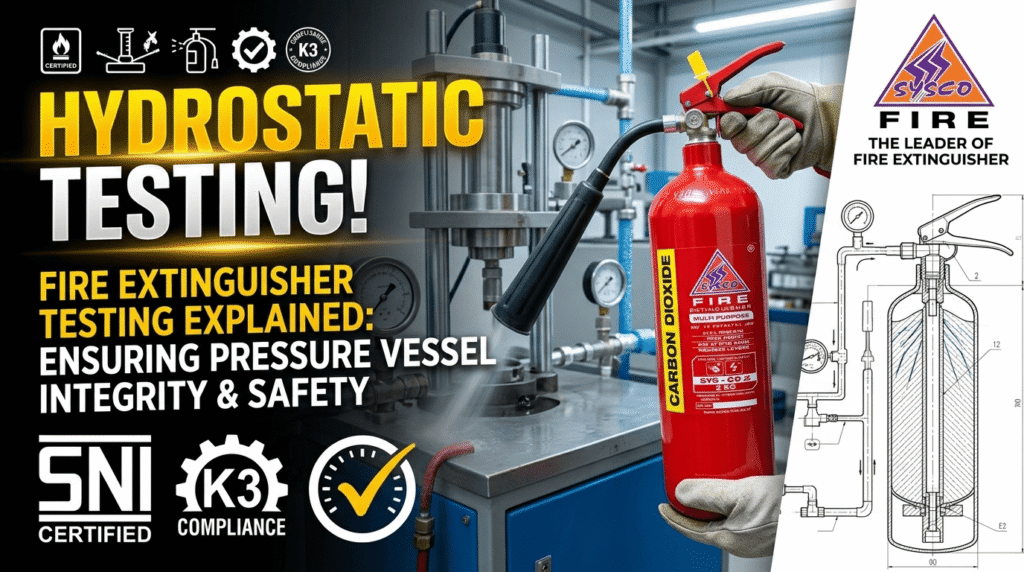
A portable fire extinguisher—locally known in Indonesia as APAR (Portable Fire Extinguisher)—is far more than a simple container holding fire-suppressing chemicals. Fundamentally, it is a high-pressure vessel operating continuously under significant internal mechanical stress. Whether pressurized with dry nitrogen gas at 12 to 15 bar or storing liquefied carbon dioxide at over 50 bar, the metal cylinder walls must withstand immense outward force every single day of their operational lifespan.
Over years of service in industrial plants, coastal warehouses, commercial high-rises, and vehicle fleets, environmental moisture, chemical reactions, physical impacts, and metal fatigue can gradually weaken a cylinder’s structural integrity. If a compromised cylinder is activated during an emergency—or exposed to extreme heat—it can rupture violently, turning a life-saving safety device into a lethal hazard.
This is precisely why Fire Extinguisher Hydrostatic Testing is mandated by both Indonesian occupational safety laws (Permenaker No. 04/1980) and international fire protection standards (NFPA 10). Written with this technical guide breaks down how hydrostatic testing works, mandatory testing intervals by extinguisher type, and how to keep your facility’s active fire protection fully compliant and safe.
Table of Contents
What Is Fire Extinguisher Hydrostatic Testing?
Fire Extinguisher Hydrostatic Testing is a non-destructive pressure verification procedure used to evaluate the structural strength, weld integrity, and elastic expansion limits of a pressurized fire extinguisher cylinder.
Rather than testing the cylinder with compressed air or nitrogen—which stores massive amounts of explosive kinetic energy if a rupture occurs—certified technicians use incompressible water. Because water does not compress significantly under high pressure, any structural failure or pinhole leak during the test results in a safe, controlled release of water rather than a violent explosion.
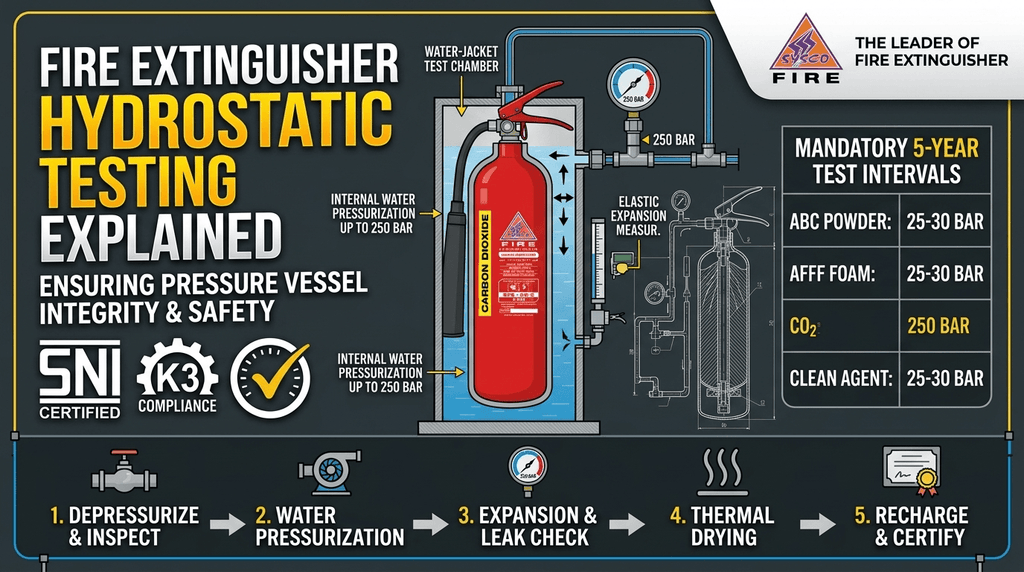
During a hydrostatic test, the cylinder is completely emptied, stripped of its valve and hose assembly, filled with water, and pressurized well above its normal operating pressure (typically to 1.5x or 2x its rated working pressure, or up to 250 bar for high-pressure CO2 cylinders). Technicians then measure whether the metal cylinder walls hold the test pressure without leaking and return to their original dimensions once pressure is released.
Why Hydrostatic Testing Is Critical for Facility Safety
Skipping or delaying scheduled hydrostatic re-certification introduces severe operational, financial, and legal risks for any organization:
1. Detecting Invisible Metal Fatigue and Micro-Corrosion
External visual inspections only reveal surface dents or exterior rust. Internal corrosion—often triggered by moisture contamination inside ABC Dry Chemical Powder or AFFF Foam cylinders—eats away at steel walls and weld seams from the inside out. Hydrostatic pressurization exposes weakened metal before catastrophic failure can occur.
2. Preventing Pressure-Vessel Rupture During Emergencies
During a fire emergency, ambient temperatures rise rapidly, causing internal cylinder pressure to spike. A cylinder that has passed its hydrostatic test is verified to handle both normal operating pressure and emergency thermal stress safely.
3. Fulfilling Indonesian K3 & Insurance Audit Requirements
Under Permenaker No. 04/1980 and SNI (Indonesian National Standard) guidelines, facility managers must maintain documented proof of periodic cylinder pressure testing. Facilities operating with overdue cylinders risk K3 audit citations, municipal fire department penalties, and invalidated commercial property insurance claims following a fire incident.
Mandatory Hydrostatic Testing Intervals by Extinguisher Type
Different extinguishing media and cylinder metallurgy experience distinct chemical and mechanical stresses. Consequently, safety standards establish strict testing schedules based on the specific type of fire extinguisher:
| Fire Extinguisher Type | Cylinder Construction | Typical Working Pressure | Hydrostatic Test Pressure | Mandatory Test Interval |
| ABC Dry Chemical Powder | Mild Steel (Stored Pressure) | 12 – 15 Bar | 25 – 30 Bar | Every 5 Years (or up to 12 years per specific SNI/NFPA manufacturer rating) |
| AFFF Foam (Aqueous Film-Forming) | Mild Steel (Lined) or Stainless Steel | 12 – 15 Bar | 25 – 30 Bar | Every 5 Years |
| Carbon Dioxide (CO2) | High-Tensile Seamless Alloy Steel | 50 – 60 Bar (at 20°C) | 250 Bar | Every 5 Years |
| Clean Agent (HFC-227ea / Halotron) | Mild Steel / Aluminum Alloy | 12 – 15 Bar | 25 – 30 Bar | Every 5 Years (or per manufacturer specification) |
| Wheeled APAB Units (Powder / Foam / CO2) | Heavy-Gauge Steel / Seamless Alloy | 15 – 60 Bar | 30 – 250 Bar | Every 5 Years |
Note: Regardless of the calendar interval, any cylinder that exhibits severe corrosion, deep dents, gouges, fire damage, or damaged threads must be removed from service immediately and subjected to hydrostatic testing—or condemned—before reuse.
Step-by-Step: Inside a Certified Hydrostatic Testing Process
When you send your APAR or APAB units to an authorized service facility like Sysco Fire, each cylinder undergoes a disciplined, multi-stage engineering protocol:
Step 1: Pre-Test Depressurization & Internal Visual Inspection
Certified technicians safely depressurize the unit, recover or properly dispose of the old extinguishing agent, and remove the forged brass valve assembly. Using a high-intensity fiber-optic inspection light, technicians examine the interior cylinder walls for pitting, rust, or lining delamination.
Step 2: Water Jacket or Direct Expansion Pressurization
The stripped cylinder is securely connected to a calibrated hydrostatic test bench and filled completely with clean water, purging all trapped air pockets. Technicians apply controlled hydraulic pressure up to the exact test rating stamped on the cylinder shoulder and hold it for a minimum duration (typically 30 to 60 seconds).
Step 3: Elastic Expansion & Leak Verification
Technicians monitor calibrated pressure gauges and expansion burettes to confirm:
- Zero pressure drop or water weeping along weld seams, neck threads, or cylinder walls.
- Permanent volumetric expansion remains strictly within allowable safety tolerances (typically under 10% of total expansion for high-pressure seamless cylinders).
Step 4: Thermal Drying & Internal Re-Conditioning
Any moisture remaining inside a dry powder or CO2 cylinder after testing will ruin the new extinguishing agent and accelerate internal rust. Tested cylinders are placed in industrial hot-air drying ovens until 100% moisture-free.
Step 5: Re-Valving, Recharging & Official Certification Stamping
Technicians install new O-rings and valve stems, refill the cylinder with fresh, batch-verified extinguishing media, pressurize the unit with dry nitrogen, and perform bubble/spectrometer leak checks. Finally, the cylinder receives an official Hydrostatic Test Certification Label/Stamp recording the test date, test pressure, and technician ID.
When Should a Cylinder Be Condemned Instead of Retested?
Hydrostatic testing validates serviceable cylinders, but safety regulations strictly prohibit retesting—and require permanent condemnation—if a cylinder exhibits any of the following defects:
- Deep Structural Pitting: Corrosion that has visibly reduced cylinder wall thickness.
- Dents on Weld Seams: Any dent or crease located directly across a longitudinal or circumferential weld.
- Thermal/Fire Exposure: Cylinders that have been exposed to direct flame or extreme heat that may have altered the steel’s metallurgical temper.
- Damaged Neck Threads: Worn, stripped, or corroded valve threads that compromise pressure-tight sealing.
Condemned cylinders are permanently rendered unpressurizable (such as punching or crushing) so they can never re-enter circulation.
Why Partner with Sysco Fire for Certified Testing & Equipment
Maintaining pressure vessel safety requires working with a manufacturer and technical service provider equipped with calibrated testing infrastructure and certified K3 personnel. Sysco Fire delivers end-to-end lifecycle reliability for industrial and commercial facilities across Indonesia:
- Factory-Grade Hydrostatic Test Benches: Calibrated high-pressure testing rigs capable of certifying both low-pressure stored-pressure units and 250-bar seamless CO2 cylinders.
- SNI & Permenaker Compliance Documentation: Full test certificates and serialized audit logs ready for corporate K3 inspections, fire department audits, and insurance underwriters.
- OEM Refilling & Genuine Spare Parts: Recharging with certified ABC Dry Powder, AFFF Foam, CO2, and Clean Agent media alongside genuine brass valves, EPDM hoses, and calibrated pressure gauges.
Conclusion
Fire Extinguisher Hydrostatic Testing is the ultimate safeguard against hidden metal fatigue, internal corrosion, and catastrophic pressure-vessel failure. By adhering to mandatory 5-year testing intervals and partnering with certified safety specialists, facility managers ensure that every APAR and APAB on-site remains structurally sound, legally compliant, and ready to perform under extreme emergency pressure.
Protect your personnel, infrastructure, and business continuity with certified cylinder testing and industrial-grade fire extinguishers today.
Baca juga : Fresh Graduates Must Know! 11 Career Opportunities in Safety to Kick-Start Your Future.
Explore Our Official Catalog and Connect with Our Experts
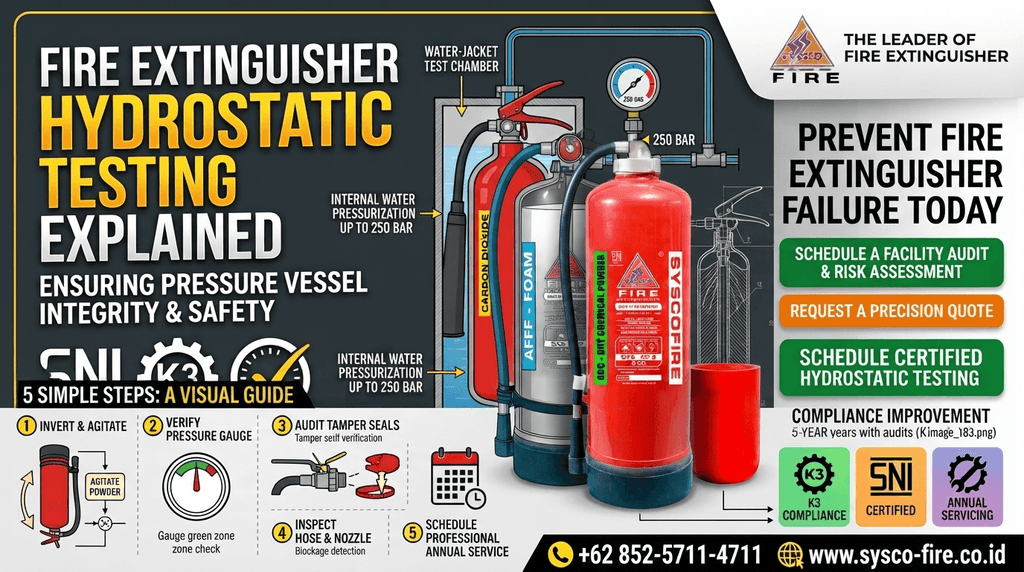
Ready to schedule certified hydrostatic testing, recharge your facility’s extinguishers, or upgrade to SNI-certified APAR and APAB units? Connect with Sysco Fire today through our official channels.
- Visit Our Official Manufacturer Website: Discover our production standards, testing facilities, and industrial fire protection portfolio at https://sysco-fire.co.id.
- Browse Our Full Product Catalog: Review technical specifications, capacities, and ratings for ABC Dry Powder, CO2, AFFF Foam, and Clean Agent extinguishers at https://sysco-fire.co.id/PROMO.
- Speak With Our Safety Consultants: Need a hydrostatic testing quote, K3 compliance audit, or bulk procurement consultation? Contact our customer service desk via WhatsApp at +62 852-5711-4711 or click here for direct assistance: https://sysco-fire.co.id/cs.