Commercial vehicles are the lifeblood of supply chains, logistics corridors, construction sites, public transport routes, and mining or energy operations across Indonesia. Unlike a static warehouse or office building, a moving vehicle operates in an unpredictable environment—subject to continuous engine heat, electrical wiring vibrations, fuel lines, hot exhaust manifolds, cargo shifts, and exposure to public roadways. When a fire starts inside a delivery truck, tanker, bus, utility van, or heavy transport rig, the window to contain it before it engulfs the cab, cargo bay, or fuel tank is measured in seconds.
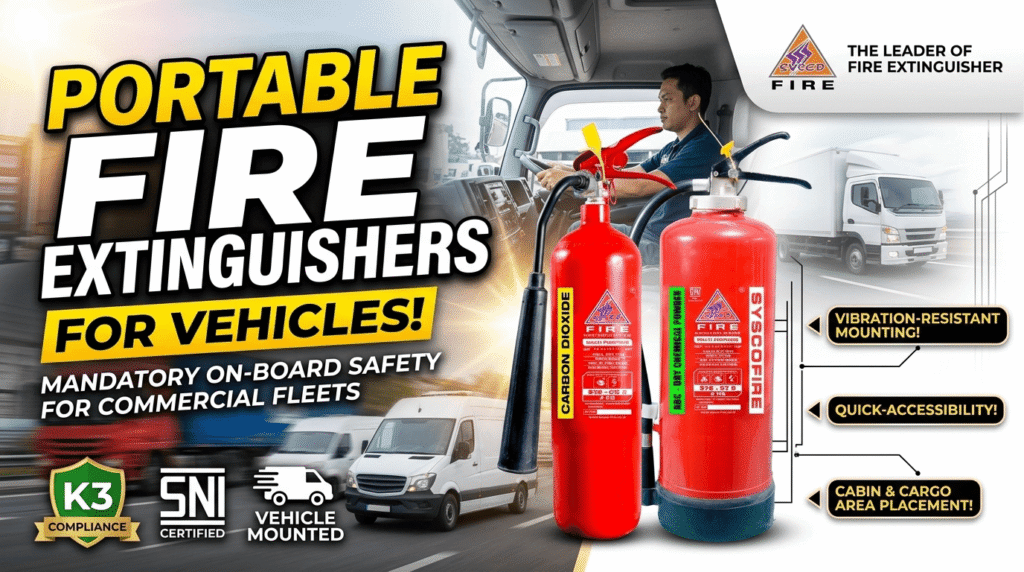
Equipping every commercial vehicle with Portable Fire Extinguishers for Vehicles—commonly referred to locally as APAR (Portable Fire Extinguisher) for automotive and fleet use—is a critical line of defense. A compact, properly rated, and securely mounted extinguisher within immediate reach of the driver can knock down an incipient electrical short circuit, overheated brake assembly, or minor fuel leak before emergency responders arrive.
Across Indonesia, workplace safety governance under Permenaker No. 04/1980 and SNI (Standar Nasional Indonesia) principles, along with broader automotive and occupational risk standards, places clear expectations on employers to protect workers and workplaces—including mobile operations and company-operated vehicles. Written in alignment with standards, this comprehensive guide examines why on-board fire suppression is essential for commercial fleets, how to select the right agent and capacity, where to mount units safely, and how to maintain fleet-wide readiness.
Table of Contents
Why Vehicle Fires Pose Unique Risks to Commercial Fleets
A fire in a commercial vehicle escalates differently than a fire in a stationary structure. Confined engine bays, pressurized fluids, high-voltage or heavy-current wiring, and flammable cargo create rapid thermal growth.
1. High-Energy Ignition Sources Under Constant Motion
Modern commercial vehicles pack dense electrical harnesses, alternators, batteries, turbochargers, exhaust after-treatment systems, and hydraulic or fuel lines into tight spaces. Chafed insulation, oil or fuel weeping onto hot surfaces, or electrical faults can ignite rapidly while the vehicle is idling in traffic or climbing steep grades.
2. Flammable Cargo and Fuel Exposure
Logistics trucks, fuel or chemical transporters, construction support vehicles, and passenger coaches carry materials that intensify fire spread once ignited—ranging from packaging, textiles, and lubricants to fuels and industrial supplies. A delay of even one minute can turn a localized spark into a total vehicle loss.
3. Driver Safety, Liability, and Route Disruption
When a vehicle catches fire on a highway, toll road, or industrial site, driver and passenger safety comes first. Beyond physical risk, fleet fires cause severe cargo damage, delivery delays, reputational harm, and potential regulatory or insurance scrutiny if basic fire prevention controls were missing.
Selecting the Right Fire Extinguisher for Commercial Vehicles
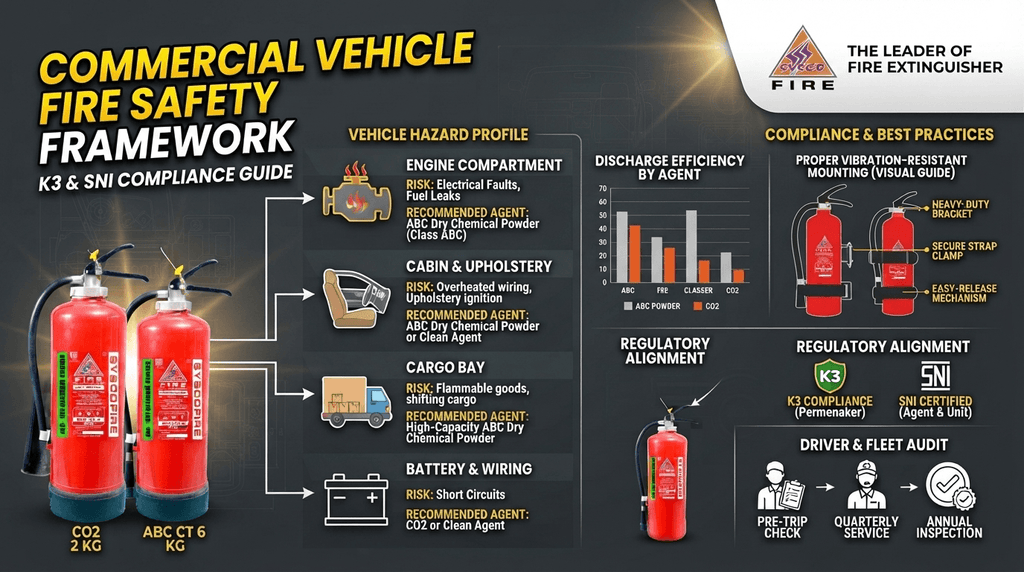
Choosing Portable Fire Extinguishers for Vehicles requires matching the extinguishing agent and cylinder size to the vehicle’s specific hazard profile, operating environment, and cab or chassis layout.
ABC Dry Chemical Powder: The Versatile Fleet Standard
For most general-purpose commercial vehicles—such as box trucks, pickups, service vans, buses, and utility fleet cars—ABC Dry Chemical Powder is widely favored because it addresses multiple fire classes in a single unit:
- Class A: Ordinary combustibles such as seat upholstery, cargo packaging, wiring insulation, and trim.
- Class B: Flammable liquids including gasoline, diesel, engine oil, brake fluid, and solvents.
- Class C: Energized electrical equipment such as vehicle battery cables, fuse boxes, alternators, and wiring harnesses.
Carbon Dioxide (CO2) and Clean Agent Considerations
- CO2 Extinguishers: Effective on electrical and flammable liquid fires without leaving powder residue, making them useful in specialized scenarios. However, in tightly enclosed passenger cabins or small cabs, operators must be mindful of ventilation and rapid gas discharge characteristics, and CO2 cylinders are heavier for a given rating.
- Clean Agent Extinguishers: Leave zero residue and are non-conductive, making them attractive where sensitive electronics or clean environments are prioritized, though cost and capacity trade-offs should be evaluated against fleet budgets.
Sizing Your Fleet Extinguishers
Fleet safety decisions should balance rapid knockdown capability with practical cab ergonomics and regulatory alignment:
- Compact Passenger & Light Commercial Vehicles: Smaller portable units (such as 1 kg to 2 kg ABC powder units) fit neatly in light vehicles or service cars where space is tight.
- Medium & Heavy Commercial Trucks, Buses, and Industrial Vehicles: Larger capacities (such as 3 kg to 6 kg ABC powder units—or higher-capacity units where hazard severity demands) provide greater discharge time and reach for larger engine bays, tires, or cargo areas.
Proper Vehicle Mounting: Accessibility, Vibration Resistance, and Safety
Even the best fire extinguisher is useless if it rolls loose under the brake pedal during sharp cornering, flies around the cabin in a collision, or is trapped inside a locked rear compartment when smoke fills the cab.
1. Strategic Placement Within Immediate Reach
- Mount the extinguisher in a location that is visible, unobstructed, and accessible from the driver’s position or immediately upon exiting the cab (for example, near the driver’s seat base, door frame area, or accessible cab mounting point, depending on vehicle clearance).
- Avoid burying the unit under spare parts, toolboxes, delivery crates, or passenger bags.
2. Heavy-Duty Brackets Built for Road Vibration
Commercial vehicles experience continuous road shock and vibration. Standard light-duty wall hooks are not designed for moving vehicles:
- Use a sturdy metal or reinforced vehicle mounting bracket with a secure retaining strap or clamp so the cylinder cannot rattle loose or detach on rough roads.
- Ensure the release mechanism is straightforward and can be unlatched quickly under stress.
3. Thermal and Environmental Protection
- Avoid mounting cylinders directly against scorching exhaust components or inside unventilated pockets exposed to extreme direct heat where internal pressure could spike abnormally.
- Protect labels, pressure gauges, and valve stems from mud, road spray, and chemical spills so inspection markings remain legible.
Fleet Inspection, Maintenance, and K3 Compliance
Vehicles face harsher mechanical conditions than indoor extinguishers, which means Portable Fire Extinguishers for Vehicles need consistent oversight as part of your fleet’s K3 (Occupational Health and Safety) and preventative maintenance program.
Routine Driver & Fleet Checks
- Pre-Trip / Monthly Visual Inspection: Verify the cylinder is firmly locked in its bracket, the pressure gauge (where fitted) is in the normal operating zone, the safety pin and tamper seal are intact, and the hose/nozzle is clear of dirt or damage.
- Post-Vibration & Impact Audits: After travel over rough terrain, construction sites, or minor jolts, check bracket bolts and strap tension to ensure nothing has loosened.
Scheduled Servicing, Refilling, and Hydrostatic Testing
- Follow structured periodic servicing intervals aligned with Permenaker No. 04/1980, SNI standards, and manufacturer guidelines.
- Dry chemical powder in moving vehicles can experience gradual settling or moisture risk if seals degrade; periodic inspection and servicing help keep the agent ready to discharge smoothly.
- Never leave a used or partially discharged extinguisher back in a vehicle—replace or recharge it immediately through a qualified service provider.
Why Partner with Sysco Fire for Commercial Fleet Protection
Outfitting an entire commercial fleet requires consistent product quality, clear technical specifications, and dependable availability across multiple vehicle types. Sysco Fire supports businesses and industrial operators across Indonesia with SNI-aligned fire extinguishers and fire safety solutions designed to help K3 officers and fleet managers standardize protection across their vehicles and facilities.
Whether you are equipping light commercial vehicles, heavy transport trucks, or supporting on-site depots and warehouses with portable APARs and wheeled APAB units, Sysco Fire helps you choose practical, reliable equipment backed by responsive technical support.
Conclusion
Portable Fire Extinguishers for Vehicles are a vital, non-negotiable safeguard for commercial fleets operating on today’s roads and job sites. Pairing the right extinguishing medium and capacity with vibration-secure mounting, driver familiarity, and routine maintenance empowers operators to stop small vehicle fires before they escalate into major disasters.
Baca juga : APAR Is Not Just for Show! 11 Procedures for Correctly Using a Fire Extinguisher in the Workplace.
Connect With Sysco Fire
Looking to equip your commercial fleet with dependable fire extinguishers or need technical guidance on APAR selection and compliance? Connect with Sysco Fire through our official channels:
- Official Manufacturer Website: Explore Sysco Fire’s profile, standards, and fire protection solutions at https://sysco-fire.co.id.
- Product Catalog: View detailed APAR and fire extinguisher options and specifications at https://sysco-fire.co.id/Promo.
- WhatsApp Consultation: Reach our customer service team at +62852-5711-4711 via https://sysco-fire.co.id/cs for product recommendations, fleet quotes, and assistance.