When a fire breaks out in a commercial building, server room, or modern office, immediate action is necessary to extinguish the flames and save lives. The most common tool deployed in such emergencies is a Dry Chemical Powder fire extinguisher—frequently designated as an ABC Multi-Purpose APAR (Alat Pemadam Api Ringan). While Dry Chemical Powder is exceptionally efficient at knocking down Class A (combustibles), Class B (flammable liquids), and Class C (electrical) fires, property managers and IT professionals often face a catastrophic second wave of damage once the flames are put out: the fine, clinging chemical residue left behind.
If you have ever wondered whether Dry Chemical Powder residue poses a severe risk to sensitive electronics, computers, servers, and microcircuitry, the direct answer is an unequivocal yes. In fact, in many electrical fire incidents, the chemical residue causes far more financial and operational destruction to electronic equipment than the actual heat or flames of the fire itself.
In this authoritative fire safety guide, we will examine the chemical composition of dry chemical powder, explain the exact mechanisms through which it ruins electronic components, detail emergency cleanup procedures, and highlight the clean agent alternatives every tech-dependent facility should implement.
Table of Contents
What Is Dry Chemical Powder Made Of?
To understand why Dry Chemical Powder (DCP) is so hazardous to electronics, one must first look at its chemical formulation. The most widely used ABC dry chemical extinguishing agent consists primarily of Monoammonium Phosphate (N H4 H2 PO4), often blended with ammonium sulfate and treated with silicone or moisture-repelling additives to allow smooth discharge through the extinguisher nozzle.
When sprayed, this agent forms a fine, fog-like cloud of microscopic chemical particles (typically ranging between 10 to 75 microns in diameter). This airborne cloud smothers the fire by breaking the chemical chain reaction and coating burning solids in a molten, suffocating crust.
While Monoammonium Phosphate works wonders at suppressing flames, its chemical properties make it inherently hostile to delicate microelectronics, delicate solder joints, and high-frequency circuit boards.
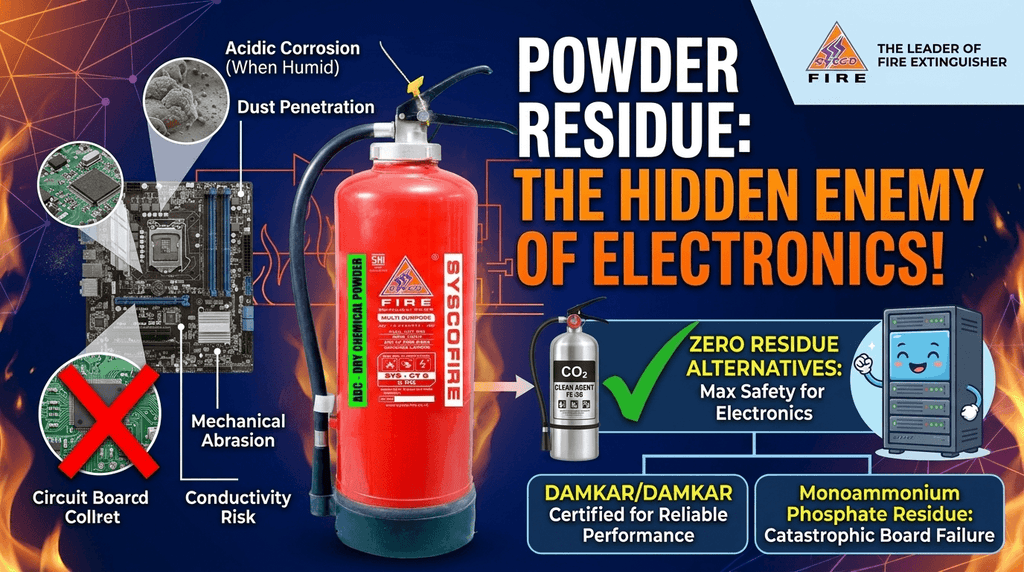
3 Ways Dry Chemical Powder Residue Destroys Electronic Devices
The destruction of electronics by dry chemical powder does not happen solely at the moment of discharge; it continues over hours and days through physical, chemical, and electrical degradation.
1. Severe Hygroscopic Corrosion
The single greatest threat posed by Monoammonium Phosphate is its hygroscopic nature. “Hygroscopic” means the compound actively attracts and absorbs moisture directly from the ambient air.
When dry chemical powder dust settles on electronic circuit boards, copper traces, and gold-plated connectors, it absorbs humidity from the room. Upon absorbing moisture, Monoammonium Phosphate dissolves and forms a highly acidic solution. This acidic film immediately begins attacking metals, dissolving delicate copper traces, eroding solder points, and oxidizing delicate micro-components. Even if a computer or server was turned off during the fire, leaving the powder on the circuit boards will cause permanent chemical corrosion within 24 to 48 hours.
2. Airborne Fine Dust Penetration and Mechanical Abrasion
Because dry chemical powder is milled into microscopic particles, it behaves like a pressurized gas when discharged. It easily penetrates the tiny ventilation slits, cooling fans, power supply grates, and ports of server racks, laptops, medical equipment, and control panels.
Once inside:
- Cooling Fan Failure: The powder acts as an abrasive, grinding down fan bearings, causing them to freeze up or burn out.
- Optical and Sensor Blockage: The fine dust coats optical sensors, laser lenses, hard drive breather filters, and switches, rendering precision equipment completely unresponsive.
3. Thermal Blanketing and Melting on Hot Components
During an active discharge, electronics that are running at normal or elevated operating temperatures (such as CPUs, GPUs, power transformers, and voltage regulators) will cause the powder to stick directly to their hot surfaces.
When the fine powder hits hot components, it melts into a glassy, sticky plastic-like glaze. This glaze creates a thermal blanket that traps heat inside the semiconductor chips. Once the system is restarted, the inability to dissipate heat leads to catastrophic thermal overload and permanent semiconductor failure.
Electrical Conductivity: The Hidden Short-Circuit Risk
In its purely dry state, dry chemical powder is an electrical insulator (non-conductive). This is why it is rated safe for Class C electrical fires up to certain voltage thresholds. However, this non-conductive property is temporary and deceptive.
As mentioned, once the powder settles inside energized electronics and absorbs moisture from the air, it turns into an acidic liquid film rich in free ammonium and phosphate ions. Ionized liquid is highly electrically conductive.
If an employee attempts to turn on a computer, router, or industrial controller that has been dusted with dry powder without proper decontamination, the conductive film will cause immediate short-circuits, arcing, power supply blowouts, and total logic board failure.
Emergency Protocol: What to Do If Powder Hits Your Electronics
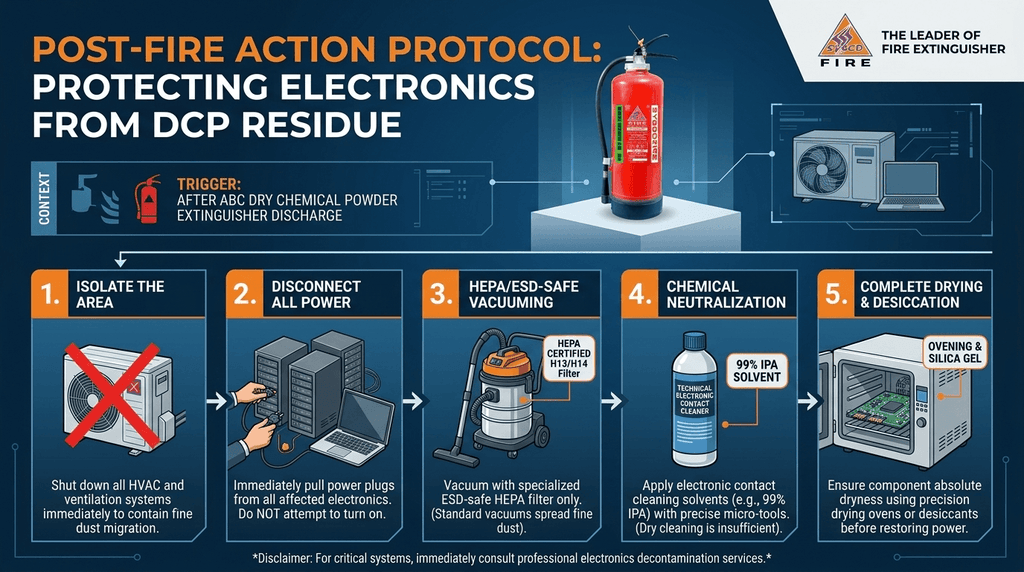
If an ABC Dry Chemical Powder extinguisher has been discharged near electronic equipment, immediate mitigation is crucial to minimize permanent damage.
- Cut the Power Immediately: Disconnect main power lines, pull power cords, and remove batteries. Never attempt to power on or operate exposed electronics.
- Isolate the Area: Turn off HVAC systems and fan units to prevent the fine powder from migrating through air ducts into unaffected server rooms or offices.
- Vacuum with HEPA/ESD Equipment Only: Do not use a standard household vacuum cleaner, as dry chemical dust will pass straight through standard filters and create massive electrostatic discharge (ESD) that destroys microchips. Use an industrial ESD-safe vacuum equipped with a certified HEPA filter.
- Avoid Compressed Air: Do not blow compressed air into electronics, as this pushes microscopic powder deeper into enclosed components and socket connectors.
- Professional Chemical Decontamination: Sensitive circuit boards must be washed using high-purity Isopropyl Alcohol (IPA 99%) or specialized electronic cleaning solvents by certified technicians to neutralize the acidic compounds before drying completely in temperature-controlled environments.
The Better Alternative: Clean Agent and CO2 Extinguishers
Because cleaning dry chemical powder residue from electronics is extremely difficult, costly, and rarely guarantees 100% recovery, modern fire safety standards (such as NFPA 75 and NFPA 2001) strongly advise against installing Dry Chemical Powder extinguishers in environments containing sensitive equipment.
Instead, facilities should be equipped with specialized “Clean Agent” or Carbon Dioxide extinguishers:
| Feature / Metric | Dry Chemical Powder (ABC) | Clean Agent (FE-36 / Clean Gas) | Carbon Dioxide (CO2) |
| Residue Left | Heavy, acidic, sticky dust | Zero Residue | Zero Residue |
| Corrosive to Metal? | Highly Corrosive | Non-Corrosive | Non-Corrosive |
| Electrical Conductivity | Conductive when humid | Non-Conductive | Non-Conductive |
| Primary Target Area | General spaces, outdoor, storage | Server rooms, data centers, labs | Electrical panels, machinery |
| Equipment Safety | Low (High risk of damage) | Maximum Safety | High Safety |
- Clean Agent APAR (FE-36 / Gas Clean Agent): Discharges as a clear gas that smothers fire at the molecular level without causing thermal shock or cold snaps, leaving absolute zero residue. Electronics can resume operation immediately after the gas vents.
- Carbon Dioxide (CO2) APAR: Suppresses fire by displacing oxygen and cooling the fire zone. It evaporates completely into the atmosphere without leaving any liquid or solid residue.
Summary & Key Takeaways
While Dry Chemical Powder extinguishers are invaluable, cost-effective tools for general fire protection in open warehouses, parking garages, and building corridors, their residue is highly destructive to electronic devices. The combination of acidic corrosion, moisture absorption, fine dust penetration, and thermal insulation makes dry chemical powder a major threat to computers, server racks, telecommunication gear, and control panels.
For any room housing critical digital assets, server infrastructure, or expensive electrical systems, replacing or supplementing dry powder units with Clean Agent or CO2 fire extinguishers is the smartest investment you can make to protect your business continuity.
Baca juga : Tingkat Training Damkar Kemnaker: 4 Level Kompetensi yang Wajib Dipahami Sebelum Sertifikasi .
Protect Your Critical Electronics with Certified Fire Safety Solutions
Don’t let chemical residue ruin your expensive IT equipment and operational infrastructure. Equip your facilities with certified, high-grade Clean Agent and CO2 fire extinguishers manufactured to strict international quality standards.
- Explore Official Fire Safety Engineering: Visit our manufacturer website at https://sysco-fire.co.id.
- Browse Clean Agent & CO2 APAR Catalogs: Find specialized fire suppression products engineered for electronics at https://sysco-fire.co.id/Promo.
- Consult Our Safety Specialists: Need expert advice on choosing zero-residue extinguishers for your server room or office? Connect directly with our technical team via WhatsApp at +62 852-5711-4711 or click here to redirect to our official service desk: https://sysco-fire.co.id/cs.