
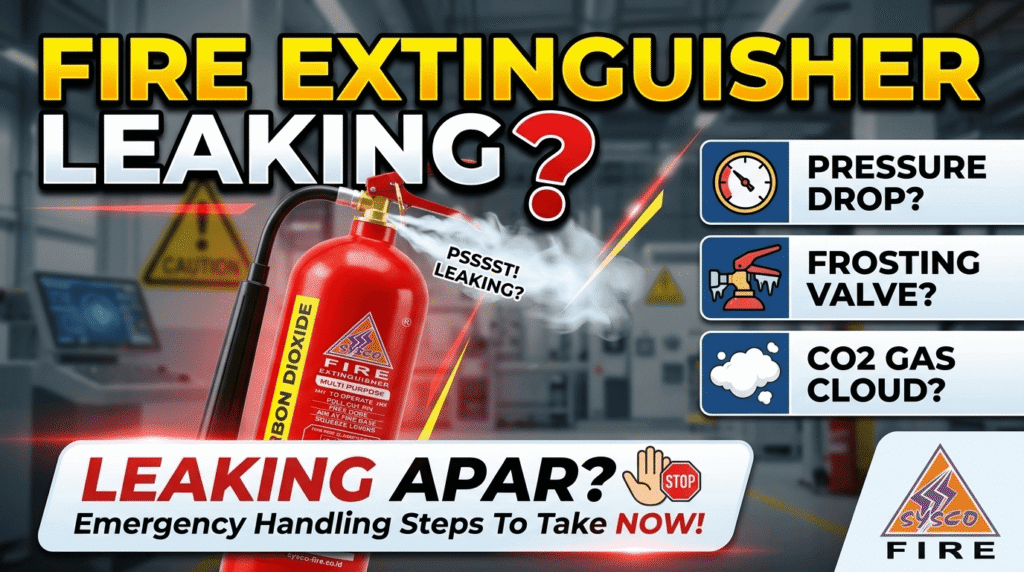
Leaking fire extinguisher units pose one of the most significant, yet often overlooked, threats to building safety and emergency preparedness. When an emergency strikes, your fire extinguisher—commonly known as an APAR (Alat Pemadam Api Ringan)—must be ready to deploy instantly. You rely on this pressurized cylinder to be your first line of defense against a growing blaze. However, what happens if that critical tool has silently lost its pressure over the past few months? A fire extinguisher is only effective if it contains both the extinguishing agent and the propellant gas required to expel it forcefully.
In this comprehensive guide, we will explore the science behind why fire extinguishers leak, how to identify the subtle and obvious signs of pressure loss, and the emergency protocols you must follow if you discover a compromised unit in your facility. Understanding these elements is not just about regulatory compliance; it is a fundamental aspect of life safety and facility management.
Table of Contents
The Anatomy of a Leak: Why Do Fire Extinguishers Lose Pressure?
To understand how to spot a leak, it is essential to first understand the anatomy of a fire extinguisher and why failures occur. A standard APAR is a highly pressurized vessel holding a firefighting agent (such as Dry Chemical Powder, Foam, or Clean Agent) and a propellant gas (usually Nitrogen). For CO2 extinguishers, the carbon dioxide itself acts as both the agent and the highly pressurized propellant.
Leaks typically occur at the weakest points of the cylinder’s construction. Here are the primary culprits behind a leaking APAR:
1. Valve and O-Ring Degradation
The valve assembly at the top of the extinguisher controls the release of the pressurized agent. Inside this assembly are rubber O-rings designed to create an airtight seal. Over time, due to temperature fluctuations, extreme humidity, or simply age, these rubber components can become brittle, crack, or shrink, allowing the microscopic nitrogen gas molecules to slowly escape.
2. Physical Damage and Mishandling
Fire extinguishers are rugged, but they are not indestructible. If an APAR is accidentally dropped, struck by a forklift in a warehouse, or bumped repeatedly, the valve stem can be bent, or the cylinder itself can suffer micro-fractures. Even a seemingly minor dent can compromise the structural integrity of the pressurized vessel, leading to a slow leak.
3. Corrosion and Environmental Factors
Placing fire extinguishers in harsh environments accelerates degradation. Units placed outdoors without protective cabinets, in high-humidity areas, or near corrosive chemicals are highly susceptible to rust. Rust eats away at the metal cylinder, particularly at the bottom seams or around the neck ring. Once the rust penetrates deep enough, the pressurized gas will find its way out.
4. Incomplete Servicing or Recharging
If an extinguisher was recently used (even for a split-second test) and not properly professionally recharged, the valve may not seat correctly. Powder from a dry chemical extinguisher can get trapped in the valve mechanism, preventing it from closing perfectly. This is why you must never “test” an extinguisher; once the seal is broken, it must be fully serviced.
Crucial Signs Your Fire Extinguisher is Leaking
Identifying a leaking fire extinguisher requires regular vigilance. Facility managers and safety officers must conduct routine visual inspections. Here are the definitive signs that your APAR is leaking and losing its firefighting capability:
1. The Pressure Gauge Needle is in the Red Zone
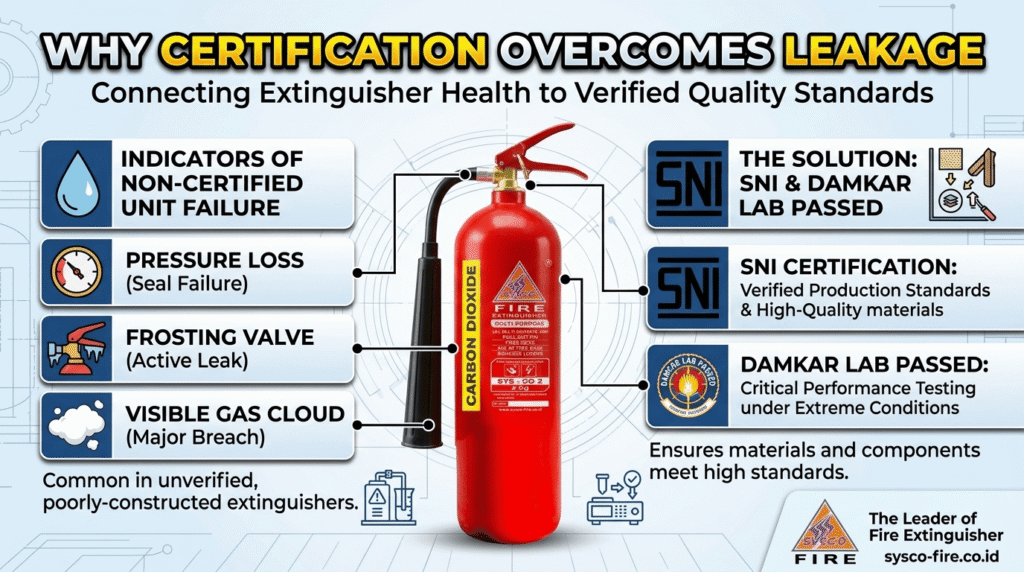
This is the most obvious indicator for extinguishers equipped with a pressure gauge (such as Dry Chemical, Foam, and Water units). A healthy, fully pressurized extinguisher will have its gauge needle pointing firmly in the green zone. If you inspect the unit and the needle has dropped into the red “Recharge” zone on the left, the unit has lost its propellant gas. It will not work in an emergency and must be serviced immediately.
2. Noticeable Weight Reduction (Crucial for CO2 Extinguishers)
Carbon Dioxide (CO2) fire extinguishers do not have pressure gauges because the pressure varies wildly with temperature. The only way to determine if a CO2 extinguisher has leaked is by weighing it. The cylinder will have a stamped weight indicating its empty weight (Tare Weight) and its full weight. If you weigh the extinguisher and it is significantly lighter than the specified full weight (typically a loss of more than 10%), it has leaked and requires immediate recharging.
3. Audible Hissing Sounds
While rare, a rapid leak can sometimes be heard. If you walk past an extinguisher or pick it up for inspection and hear a faint hissing sound coming from the valve area, the pressurized gas is actively escaping. This usually indicates a severe failure of the O-ring or valve stem.
4. Visible Powder Residue Around the Valve or Nozzle
For Dry Chemical extinguishers, the escaping propellant gas will often carry tiny amounts of the chemical powder with it. If you notice a fine coating of yellow, blue, or white powder accumulating around the neck of the cylinder, the discharge lever, or inside the hose/nozzle, it is a strong indicator of a micro-leak through the valve assembly.
5. Severe Rust, Corrosion, or Pitting
Inspect the cylinder body meticulously, paying close attention to the bottom edge and the welds. If you see deep rust or pitting (small craters in the metal), the structural integrity is compromised. Even if the gauge still reads green, a heavily corroded extinguisher is a ticking time bomb that could leak rapidly or, worse, rupture under pressure.
The Hidden Dangers of a Leaking APAR
Ignoring a leaking fire extinguisher is a critical safety failure. The dangers extend far beyond simply not having a working tool.
- Total Failure During an Emergency: The most immediate danger is that the extinguisher will fail to discharge when a fire breaks out. The user will pull the pin, squeeze the lever, and absolutely nothing will happen, allowing the fire to grow uncontrollably.
- The False Sense of Security: A bright red cylinder on the wall provides a psychological sense of safety. Occupants believe they are protected. A leaking, non-functional extinguisher provides a false sense of security, which can delay evacuation and lead to tragic outcomes.
- Regulatory and Insurance Penalties: During safety audits by local authorities (Damkar) or insurance inspectors, non-functional fire extinguishers will result in severe penalties. If a fire occurs and it is discovered that the safety equipment was not maintained, your insurance claims may be completely denied.
Emergency Steps: What to Do If You Discover a Leak
If you identify any of the signs mentioned above during your monthly safety walk-through, you must take immediate action. Treat a leaking fire extinguisher as a hazardous situation.
Step 1: Do Not Attempt to Test It
Never squeeze the lever to see if anything comes out. If there is a small amount of pressure left, you might release it, but you also risk worsening the leak or causing the weakened valve to fail completely.
Step 2: Carefully Isolate the Unit
Gently remove the extinguisher from its wall bracket or cabinet. Carry it carefully by the bottom and the handle (do not squeeze the lever). Move it to an isolated, well-ventilated area away from high-traffic zones, heat sources, and direct sunlight.
Step 3: Tag It Out of Service
Place a highly visible “OUT OF SERVICE” or “DO NOT USE” tag on the extinguisher. This is crucial so that in the event of an emergency, someone does not grab the broken unit thinking it will save them.
Step 4: Replace It Immediately
Do not leave the area unprotected. Immediately replace the leaking unit with a fully functional, properly rated spare extinguisher from your inventory to maintain your building’s fire safety compliance.
Step 5: Contact Professional Fire Protection Services
Do not attempt DIY repairs on a highly pressurized vessel. Contact a certified fire protection company immediately. Professional technicians have the correct tools, safety equipment, and knowledge to safely depressurize the unit, dismantle the valve, identify the source of the leak, replace damaged components, and professionally recharge the cylinder according to SNI and NFPA standards.
The Importance of Professional Maintenance
The best way to handle a leaking fire extinguisher is to prevent the leak from happening in the first place through rigorous, professional maintenance. Monthly visual inspections by your staff are vital, but they must be paired with mandatory annual professional servicing.
During an annual service, certified technicians do more than just look at the gauge. They check the hydrostatic test dates, weigh the units precisely, inspect the internal mechanisms, and ensure the chemical agents have not caked or degraded. Investing in high-quality, certified fire extinguishers and maintaining them properly is an investment in the survival of your business and your people.
Conclusion
A leaking fire extinguisher is a compromised piece of life-saving equipment that offers nothing but a false sense of security. By understanding the signs of pressure loss—such as a dropping pressure gauge, reduced weight, visible rust, or chemical residue—you can catch these failures before an emergency occurs. Always handle leaking units with care, isolate them immediately, and rely on certified professionals for repairs and recharging. Fire safety leaves no room for compromise; ensure your equipment is always ready for action.
Baca juga : 7 Hal yang Wajib Anda Tahu Sebelum Memilih Kontraktor Hydrant.
Upgrade to Premium, Leak-Resistant Sysco Fire Extinguishers
Don’t let a faulty, leaking APAR compromise your safety. Equip your facility with highly durable, SNI-certified fire extinguishers manufactured to the highest standards to prevent leaks and guarantee performance.
For comprehensive information about our company and our commitment to uncompromising fire safety, visit the https://sysco-fire.co.id.
Explore our full catalog of premium, lab-tested fire extinguishers tailored for commercial, industrial, and residential needs at the https://sysco-fire.co.id/Promo .
Need immediate assistance replacing a leaking unit or scheduling professional maintenance? Contact our expert team via WhatsApp at +62852-5711-4711 for fast, reliable support.